
The 5th University of Cumbria Project Management Summer School took place June 24-25 this year. This event is a celebration of Project Management aimed at the 1500+ apprentice project management students of the university and their employers. It takes place at the beautiful Lancaster Campus of the University and acts as an opportunity for all the students to meet each other, as well as the tutors of these mainly online degrees.
This year the theme was ‘Partnerships’. Three impressive keynote presentations acted as the kernel around which a number of interesting and imaginative active workshops took place, sometimes three at a time, making it difficult to choose where to go. It is always a sign of a great event when there is so much to do that you need to sacrifice your attendance to one event because there is another interesting event running at the same time.
The first keynote was by Loren Redmond, the Nuclear Waste Services’ Enterprise Portfolio Management Office Head who focused on The Intelligent Client and Their Role in Delivering Successful Projects. It is always pleasing to listen to a confident and insightful speaker who is keen to share her knowledge with ease. I am sure many students in the audience will have added a role model to their aspirations after hearing her talk.
The second keynote was not by a practitioner, but by an academic practitioner. Dr David Murphy, Emeritus Associate Professor of Sustainability Partnerships of the hosting university, informed us on From Projects to Partnerships: Principles-based and Relational Approaches to Stakeholder Engagement in project management contexts. While the speaker carries an impressive work-based CV, the academic overtones of his talk are reflected in his chosen title which came to us complete with a reading list. It was a lovely contrast from the first keynote by someone with an impressive career in one important industry – the Nuclear Industry in this case – to the more globetrotting perspective of the second keynote that brought insights from projects involving the United Nations, Climate Change and Sustainability Programmes that involve multinational stakeholders. As an academic, I had to smile with the expectation of the speaker that we would have come prepared by first studying his reading list. The research of the professor is very relevant to the global challenges we face and well worth studying.
The third keynote balanced beautifully between the other two and provided yet another perspective of the partnership nature of our profession. Neil Horner, director of his P34B project management consultancy SME, who also had a hand in organizing the event, talked on Utilising Your Ongoing Project Experiences to Mature Personal and Organisational Practice. While the first two keynotes focused more on the challenges and skills required by a project manager today, Neil turned his attention to the students and gave them food for thought on how to boost their confidence through storytelling to get their ideas across a varied audience.
In between the workshops, there was another common event where a panel of representatives from five professional bodies offered ‘Cross Profession Perspectives on Project Management and What Professional Bodies can do’ to support the careers of the student audience. As if galvanised by the theme of the summer school, all five representatives where united in suggesting that we all share a vision and a passion for creating a better future for humankind and the world we live in. The five professional bodies who answered the call of the University of Cumbria’s lecturers where the Association for Project Management, the Institution of Civil Engineers, the Project Management Institute, the Nuclear Institute, and the Institute of Chemical Engineers.
The variety of workshops reflected the enthusiasm of the teaching team. As an academic myself, I never seize to be amazed by the dynamism and dedication of some of my colleagues who will go the extra mile to inspire their students. The highlight, if I’m forced to choose just one, was The BIG Quiz, to be done by groups of students without the help of their mobile phones! The quiz consisted of 20 project management questions, a crossword puzzle of APM terms (which I have yet to tackle) and three photograph questions depicting projects the students should have been aware of. The aim of the quiz was to remind students that in a conversation with their colleagues they need a decent command of the terminology of our profession; imagine meeting the CEO in an elevator and expect them to wait patiently while you ask your AI about a word you should have known, or worse, being asked by the said CEO what is your opinion about an ongoing project and you having no idea what they are talking about.
I do not know who generated the quiz, so I will thank Charles Dobson and Ross Lishman of the University of Cumbria who I’m sure will extend my thank you to anyone else who contributed in organising this thought-provoking event.
I will leave you with two of the quiz questions:
- In the early stages of a project a ROM estimate may be produced. What does ROM stand for?
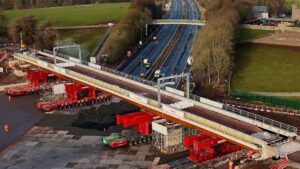
- Which village on the M6 witnessed this impressive bridge replacement project earlier this year?
Dr Nicholas Lambrou, Emeritus fellow at the University of Westminster, PMI UK Chapter Chair of London Branch