Events
Learn, meet and grow — online and near you.
Webinars, branch meetups and Toastmasters sessions. Almost everything is free.
October
-
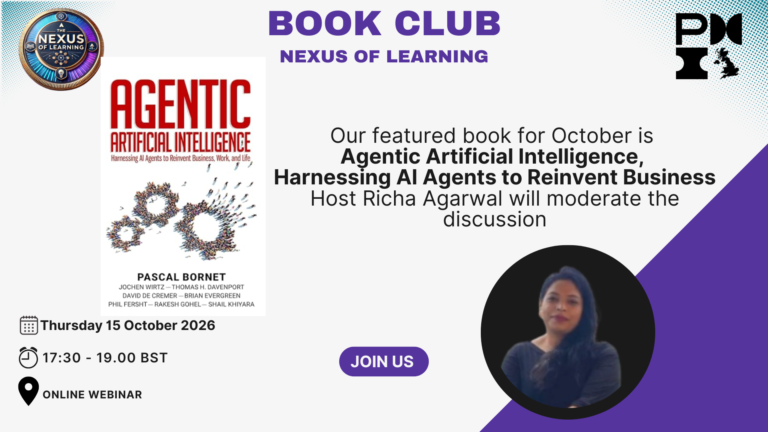
In this edition of the Nexus of Learning Book Club, we use Agentic Artificial Intelligence by Pascal Bornet as a springboard to explore a much bigger question: How should project leaders operate when AI systems are no longer just tools but autonomous collaborators?
Agentic AI represents the next phase of digital transformation. Many organizations are already experimenting with generative AI, but very few are structurally prepared for systems that can reason, plan, trigger workflows, and operate with semi-autonomy. This book was selected because it shifts the conversation from AI as a capability to AI as a transformation catalyst that reshapes governance, delivery models, and leadership accountability. This session goes beyond summarizing the book. Instead, it translates the concept of agentic AI into practical enterprise scenarios—banking modernization, AI-driven automation, governance-heavy production environments, and cross-border transformation programs.
-
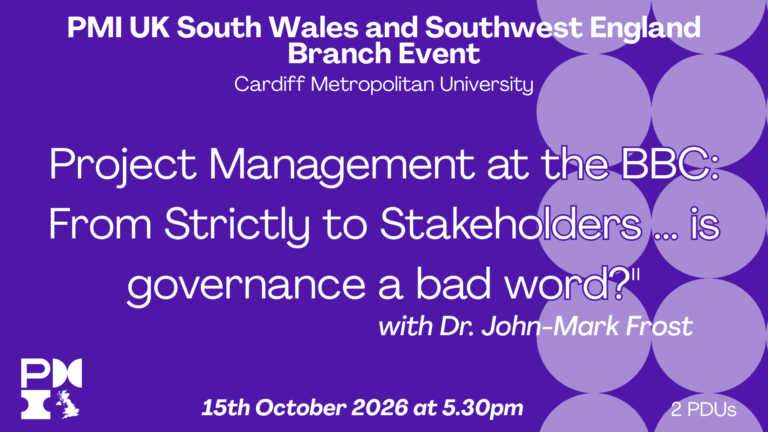
The talk will highlight some of the challenges of implementing project management within the creative industries, highlight the approach taken at the BBC and the outcomes achieved. JM will also outline the diversity of projects that the BBC undertakes and the challenges and successes they have experienced before setting out a view of the profession in the next few years at the corporation.
-
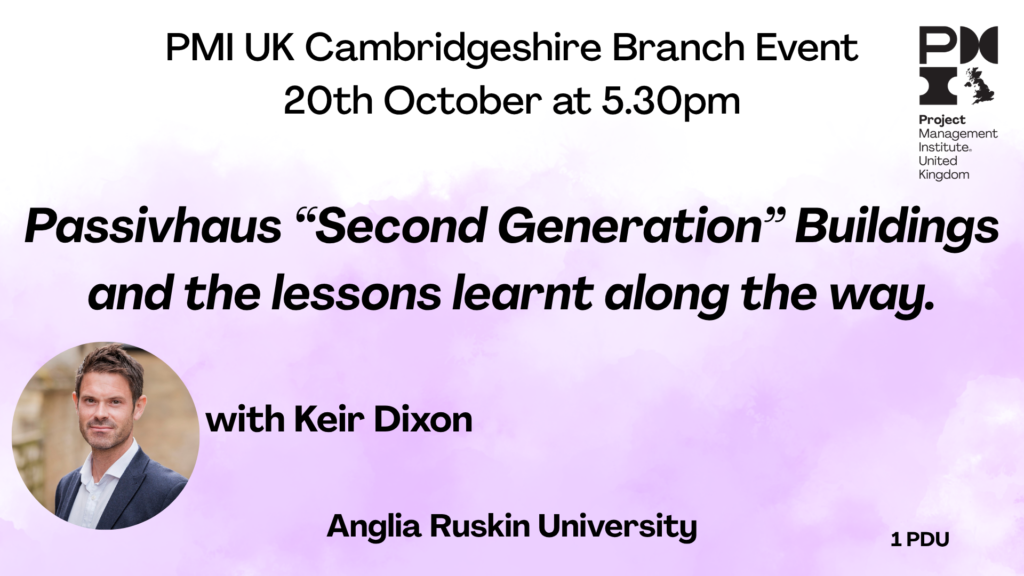
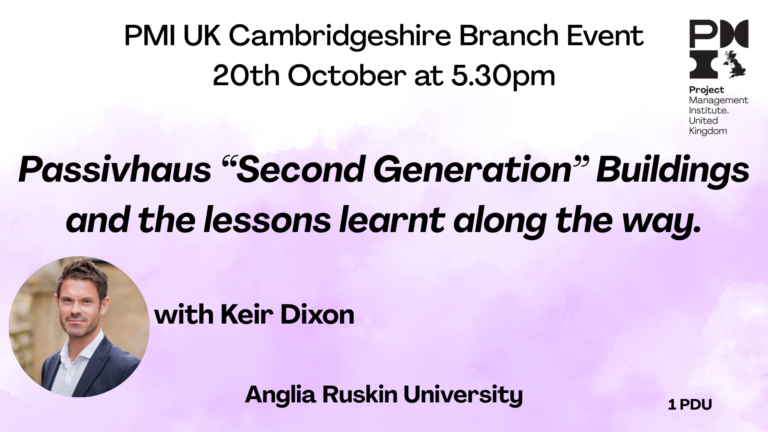
The presentation looks to review a pair of recent Passivhaus accommodation schemes; Hinsley Lane (the largest Passivhaus scheme in Cambridge) and Mount Pleasant (which when completed, will be the second largest Passivhaus scheme in Cambridge). Both undertaken for St John’s College.
The focus of the presentation will be in reviewing the lessons learnt in the first scheme and how via appropriate management, these have been incorporated into the latter scheme to reduce risk and improve programme.
-
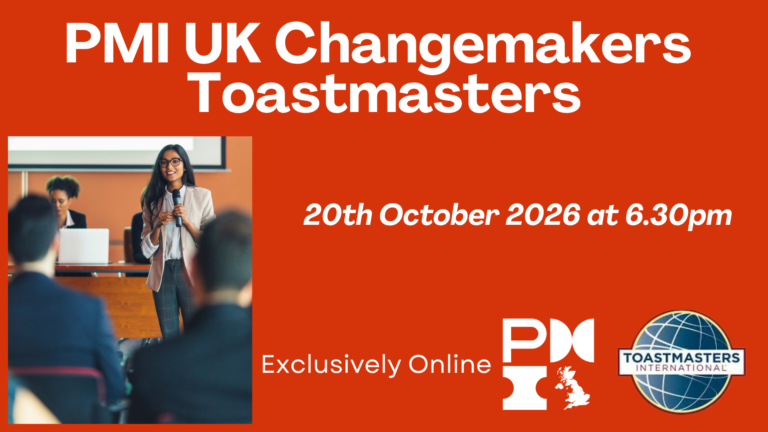
PMI UK Changemakers will give you the skills and confidence you need to effectively express yourself in any situation. Public speaking is a key project management skill and Changemakers is an efficient, enjoyable and affordable way of gaining great communication and leadership skills. By learning to effectively formulate and express your ideas, you open an entirely new world of possibilities. You’ll be more persuasive and confident when giving presentations and you’ll improve your one-on-one dealings with others.
-
AI is the new kid on the block, the new disruptor, but it does not look like the previous disruptors; this one seems to move much faster and affect more industries than previous disruptors; but is this true, or are we magnifying its effect because we cannot yet see when the disruptor will abate as we arrive at a new normal?
We have been living within a technological revolution for some time now as the digital age we have created sends us wave after wave of now propositions. Is AI the tsunami we imagine, or just another of those waves?
AI is not the first, and will not be the last, technological upheaval. We have faced many such upheavals throughout our history, and we have not only endured them all, but we have used them to improve our lives. Every time a new invention arrives, it renders many skills obsolete, but many more skills are born as a result. Now that we drive, we no longer need to know how to ride – and the price of a car is not that different from what the price of a horse used to be.
The presentation will use PMI’s Talent triangle as a map to discuss which skills are the most perishable, which are durable, and which the most enduring. In other words, which skills will be heavily influenced by AI and which still have a shelf-life.
-
Thanks to the power of AI, the next generation of project delivery won’t be managed, it will be orchestrated, seamlessly, silently, invisibly. It just might be the end of project management as we know it and the beginning of something radically smarter, but will humans still be involved and, if so, how?
The presentation offers an essential and thought-provoking guide to evolution for forward-looking leaders, digital transformation strategists, and change agents who are planning for the long game.
Are you ready to disappear?
Expect a highly interactive and fun fuelled conversational session.
-
Project success depends on more than plans, processes and technical expertise ultimately, it’s about people. In increasingly global and multicultural teams, project professionals need the ability to communicate, collaborate and build trust with colleagues, stakeholders and clients who may communicate and work very differently, and this can impact project team cohesion and ability to deliver.
In this interactive session, Victoria Rennoldson, author of Become a Global Leader, explores how Cultural Intelligence (CQ) helps leaders and project professionals navigate differences with greater confidence and adaptability.
Through practical frameworks and strategies, you’ll discover how culture influences your behaviours and decisions, learn to recognise different behavioural preferences, and gain some starter strategies to flex your communication, strengthen relationships and manage challenges across diverse teams.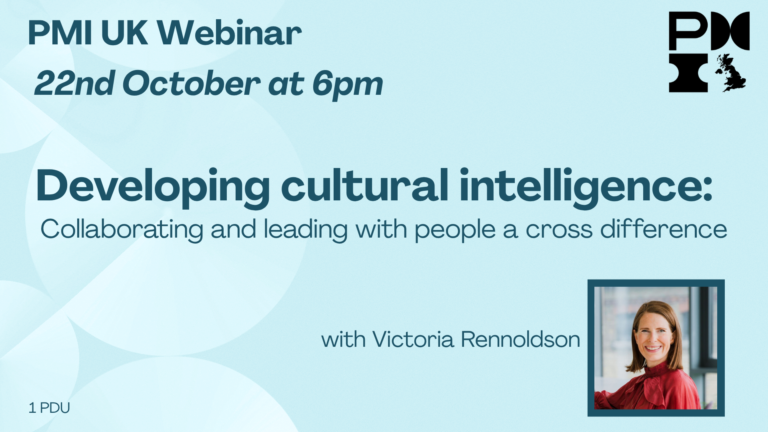
-
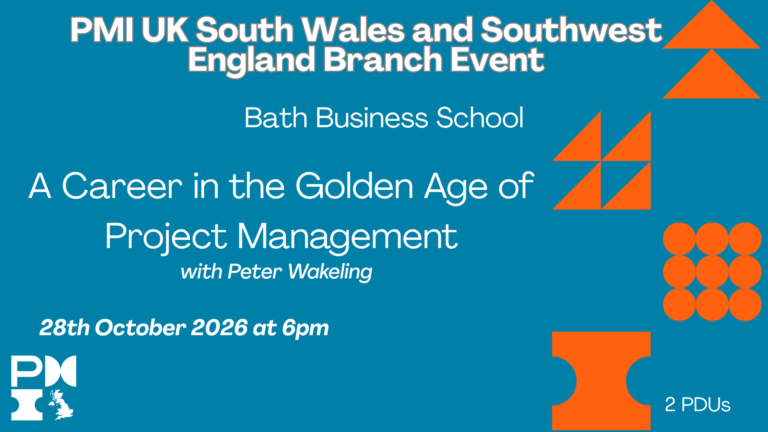
Synopsis:
- How I became a project manager
- Major milestones in formalised project management
- Opportunities and Challenges
- Operating a Centre of Excellence or PMO
- LFE and EVM
- Milestones in the Evolution of the PM Profession
- Keys to Project Success
- Was this the Golden Age of PM?
- What does the future hold for PM?
-
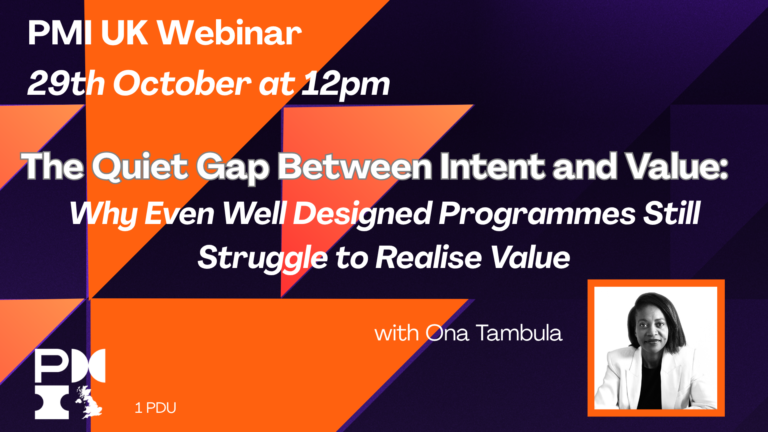
Despite advances in programme management, governance and benefits management, well-designed programmes can still struggle to realise the value they were intended to create. Why?
This webinar explores whether part of the answer lies beyond methodologies and delivery frameworks, within the organisational conditions that shape behaviour, decision making and what becomes legitimate throughout programme delivery.
The session introduces the Behavioural Theory of Value Realisation, a practitioner-led perspective on how organisational conditions shape behaviour and influence whether intended value is ultimately realised.
Participants will leave with a different way of thinking about the gap between successful delivery and realised value, together with questions they can apply to their own programmes and organisations.
-
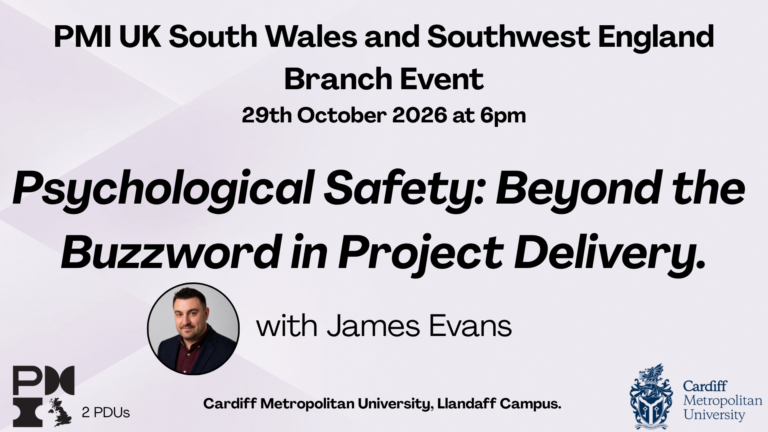
This event, Psychological Safety: Beyond the Buzzword in Project Delivery, takes a practical and honest look at what psychological safety really means in the context of delivering projects, programmes, and portfolios. It moves beyond theory to explore the real behaviours, signals, and environments that either enable or undermine open communication.
We will examine common delivery challenges such as “green” reporting masking underlying issues, the impact of fear on escalation, and the unintended consequences of traditional governance approaches. More importantly, we will focus on what can be done differently, at individual, team, and leadership levels, to create conditions where people feel able to speak up early, challenge constructively, and contribute fully.
The session will provide actionable insights and practical takeaways that can be applied immediately, helping to reduce delivery risk, improve transparency, and ultimately enhance project outcomes.
November
-
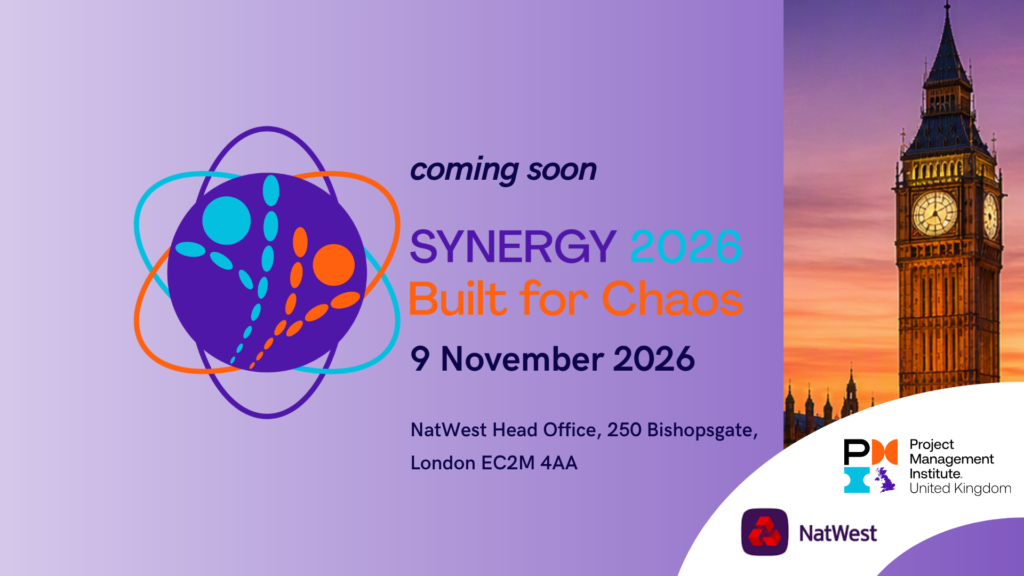
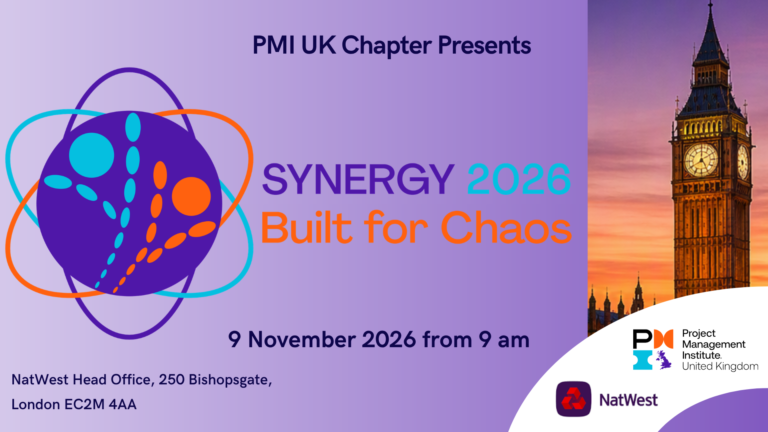
The next 30 years won’t be calm — they’ll be fast, complex, and unpredictable. Synergy 2026: Built for Chaos is your front‑row seat to the future of project leadership. This year’s flagship event is engineered for professionals who don’t just survive chaos — they design systems that thrive in it.
Synergy 2026 brings together the very best of PMI and the project profession, showcasing the ideas, talent, and innovation that will shape the decades ahead.
Join us for a high‑energy day featuring:
- Impactful talks from leaders redefining the future of work
- Deep dives into complexity, resilient delivery, AI — plus practical tips and tools to help you navigate what’s coming next
- A powerful exploration of the human side of project leadership — the emotions, motivations, and personal stories that drive us through uncertainty
- Youth innovation, global perspectives, and real‑world transformation stories
Doors open at 09:00, with energising sessions, networking breaks, and future‑focused ideas throughout the day.
Full agenda and speaker lineup coming soon — secure your place early.
-
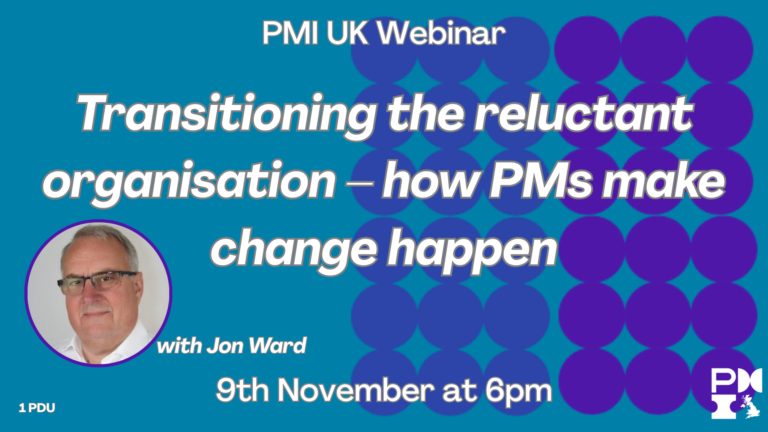
Strategy rarely fails in the boardroom; it fails in the corridors, meetings and inboxes where leaders interpret, adjust and quietly block the call to action. This presentation tackles the most stubborn problem in enterprise change: how to actually get a reluctant organisation to move.
This session explores the political nature of organisations, the mechanics of mobilising a “volunteer army” of middle managers and below, and the quarterly cadence that turns strategy into delivered outcomes.
Participants leave with a working influence map of their own context, a designed first sprint they can run inside their organisation (or their client’s), and seven design principles for getting bottom-up change off the ground.
-
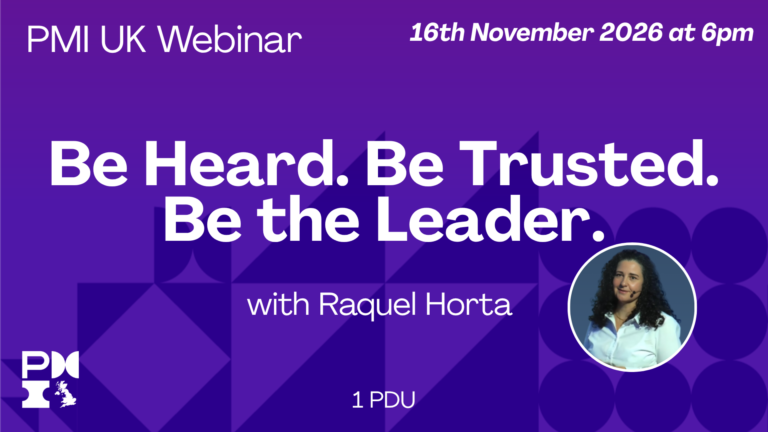
Technical skills get you hired. Power skills get you heard, trusted, and promoted.
In today’s complex project landscape, project and program managers are expected to lead without always having formal authority, managing stakeholders, navigating resistance, and driving decisions in environments that rarely stop to wait for clarity.
In this 60-minute webinar, Raquel Horta – coach, consultant, and author of Power Skills: The Human Edge in Project and Program Management – explores the skills every PM needs to increase their influence.
-
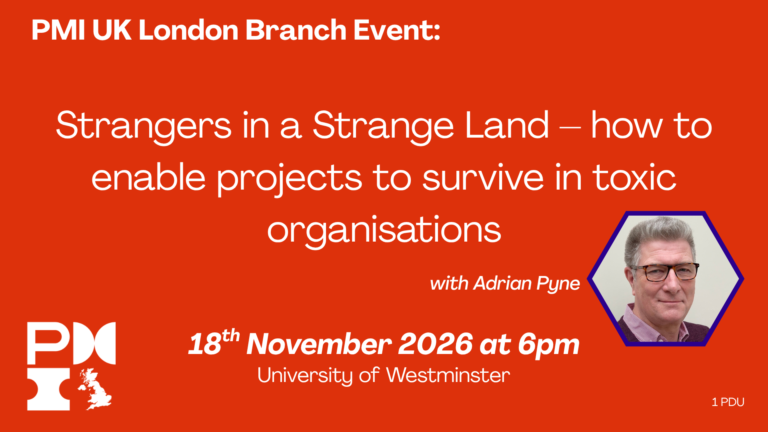
For decades, project professionals have known they need to fight for their project’s survival against organisation cultures that are toxic to projects – even without trying to be. Such toxic cultures ensure the persistent 40-70% failure rates. Organisations that create AND sustain cultures in which projects can thrive, not surprisingly have high success rates.
In this session Adrian will outline the results of a semi-academic research paper into project failure. He will describe the Two Geographies of Projects – the Internal project one, and the External organisational landscape. And how they impact project success.
Adrian will also use his Organisational PM Framework™ to show how to create AND sustain landscapes for project success.
By the way, this goes WAY beyond anything in PM BoK 8.
-
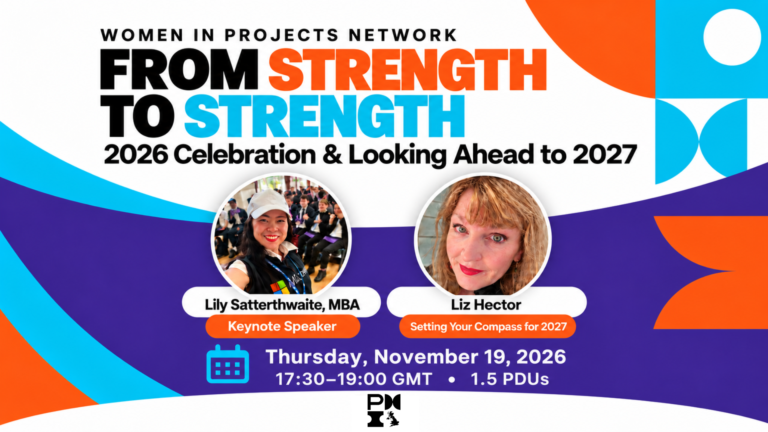
Join us to celebrate a year of learning, inspiring speakers, and connections across the Women in Projects Network. We’ll begin with a look back at 2026 and what’s ahead, hear Lily Satterthwaite’s keynote, From Strength to Strength, and then turn to Liz Hector’s practical reflection on setting your compass for 2027. We’ll finish by connecting with one another.
-
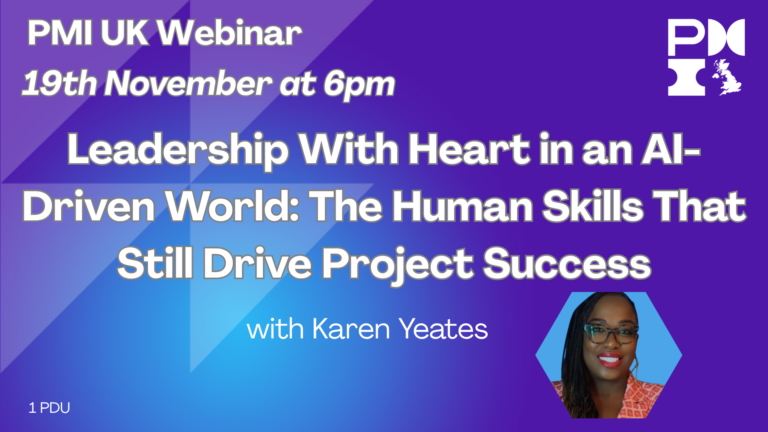
As artificial intelligence, automation, and digital transformation reshape the workplace, project leaders are navigating a new reality: increasing complexity, faster decision cycles, evolving stakeholder expectations, and growing pressure to deliver results. Yet amid rapid technological change, the most critical differentiator for project success remains deeply human. This engaging and practical session explores the role of emotional intelligence, empathy, communication, adaptability, and human-centered leadership in modern project environments. Participants will examine how emotional intelligence supports stronger stakeholder engagement, more effective communication, improved conflict navigation, resilient teams, and healthier leadership practices — particularly in environments influenced by AI, digital transformation, and continuous change.
Attendees will leave with actionable strategies to enhance their emotional intelligence, strengthen leadership effectiveness, and lead projects with greater confidence, influence, and human connection in an increasingly digital world.
December
-
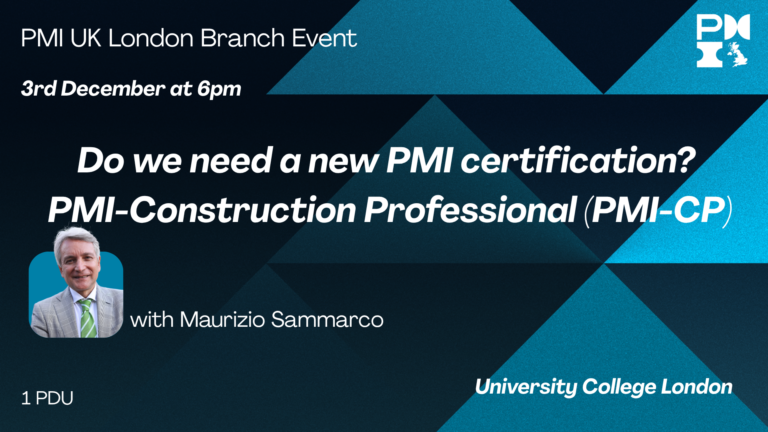
The session will also examine the certification pathway, eligibility requirements, and potential career benefits for construction professionals.
Whether you are an experienced project manager, an emerging construction professional, or a student considering a career in construction project management, this session will help you understand whether PMI-CP could be the right next step in your professional development.
Join us for an interactive discussion on the evolving competencies required to deliver successful construction projects and the role of professional certifications in shaping the future of the industry.
-
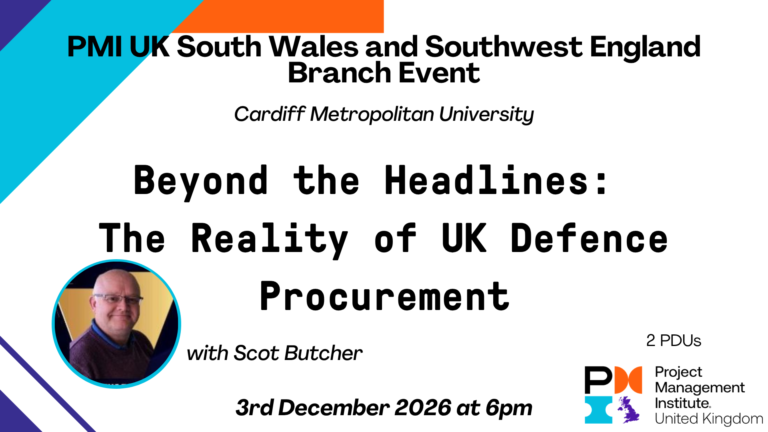
If you read the UK press, the UK has an almost exclusively poor record on defence procurement and, seemingly, the larger the programme the worse the performance.
Based on over 30 years working on major defence projects in the air and submarine sectors, Scot will unpick this premise and show that, while it’s not all good, it’s not all bad either. Using real examples (potentially anonymised to protect individuals and security), Scot will identify areas of continued weakness and ongoing strength. Rather than make this a one-way presentation, Scot would welcome a discussion on how we might overcome the former and build on the latter.
The four threads that Scot will pull on are:
- Entry-ism: Starting projects on the wrong footing
- Governance and decision making: both internal and external to the projects
- Lack of consistent structure and formality in the way we manage projects
- Change and change management
January 2027
-
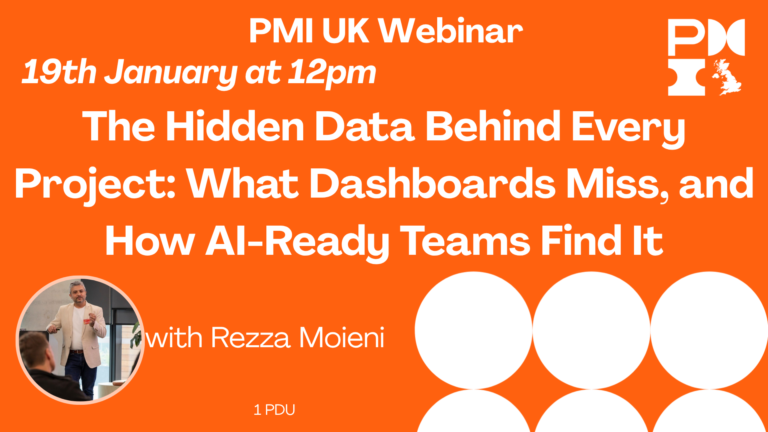
Drawing on real-world experience leading AI and technology teams, developing the Atlas platform, and researching human-centred innovation, Rezza demonstrates why these often-overlooked factors are stronger predictors of project outcomes than traditional metrics alone.
Attendees will discover how artificial intelligence and data-driven approaches can help reveal these invisible signals, enabling project managers to identify risks earlier, strengthen collaboration, and make better decisions. The session also unpacks what AI readiness really means for a project team: the skills, trust, and culture that need to be in place before AI can be implemented well, and practical lessons from putting AI to work inside real teams. The future of project management is not just measuring projects better. It is measuring people better, ethically and responsibly.
-
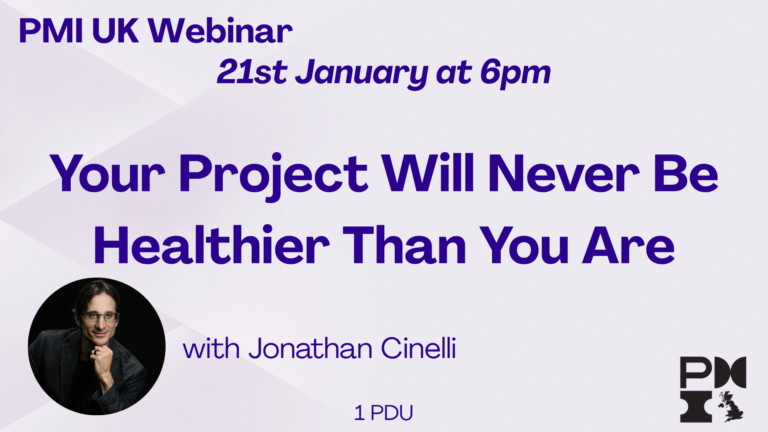
We spend our days firefighting—reacting to issue after issue until we’re exhausted and our projects suffer. Your project will never be healthier than you are.
This session unpacks why protecting your own energy is one of the best investments you can make in your project. You’ll leave with practical ways to show up more intentionally in conversations and calls — and how that directly shapes trust, decisions, and outcomes.
When we take care of ourselves, we lead better. And when we lead better, our projects follow.
February 2027
-
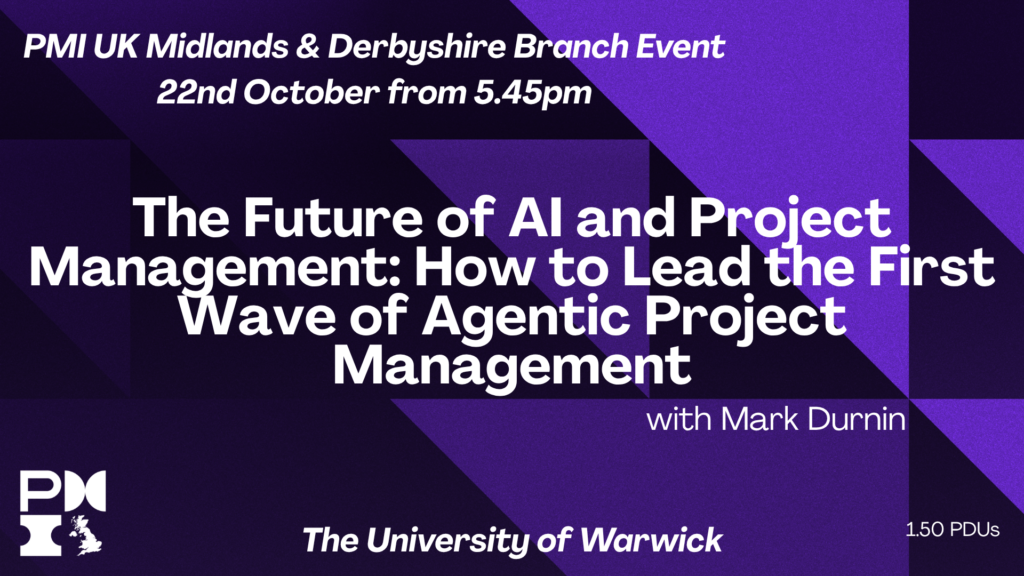
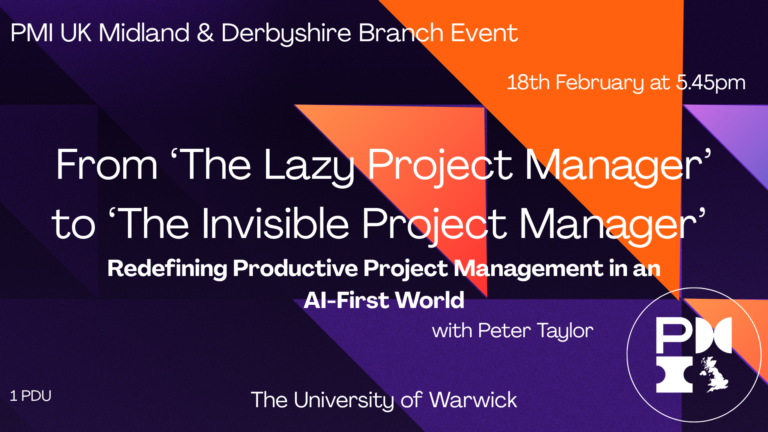
Thanks to the power of AI, the next generation of project delivery won’t be managed, it will be orchestrated, seamlessly, silently, invisibly. It just might be the end of project management as we know it and the beginning of something radically smarter, but will humans still be involved and, if so, how?
The presentation offers an essential and thought-provoking guide to evolution for forward-looking leaders, digital transformation strategists, and change agents who are planning for the long game.
Are you ready to disappear?
Expect a highly interactive and fun fuelled conversational session.
No events match your search.