Events
Learn, meet and grow — online and near you.
Webinars, branch meetups and Toastmasters sessions. Almost everything is free.
November
-
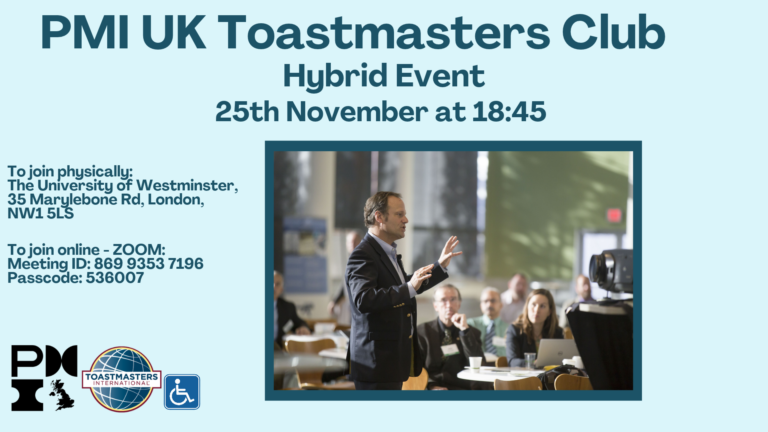
PMI UK Toastmasters will give you the skills and confidence you need to effectively express yourself in any situation. Public speaking is a key project management skill and Toastmasters is an efficient, enjoyable and affordable way of gaining great communication and leadership skills. By learning to effectively formulate and express your ideas, you open an entirely new world of possibilities. You’ll be more persuasive and confident when giving presentations and you’ll improve your one-on-one dealings with others.
-
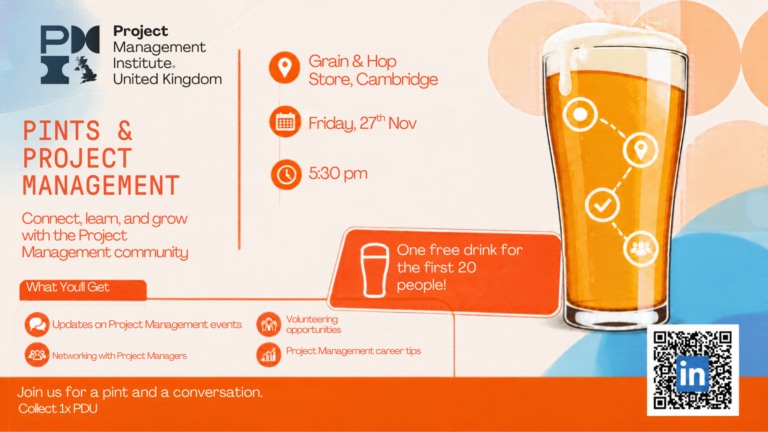
🍺 Are you at the start of your career as a Project Manager, or thinking about transitioning to Project Management?
Come and talk to us in an informal setting over a pint! 🍻
Whether you have burning questions about career development, want to learn more about transitioning roles, or simply want to expand your local professional network, the PMI UK – Cambridgeshire Branch team is here to help and answer your questions.
December
-
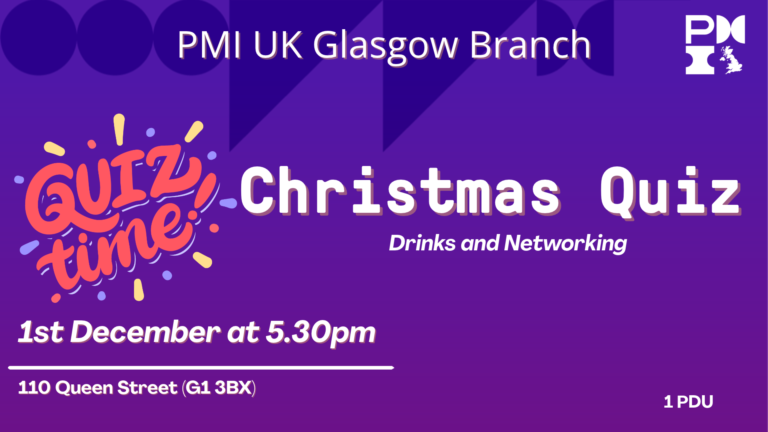
🎄 Get into the festive spirit with us!
Join us for a fun Christmas Quiz, followed by drinks and the opportunity to relax, connect and network with like-minded project professionals.
-
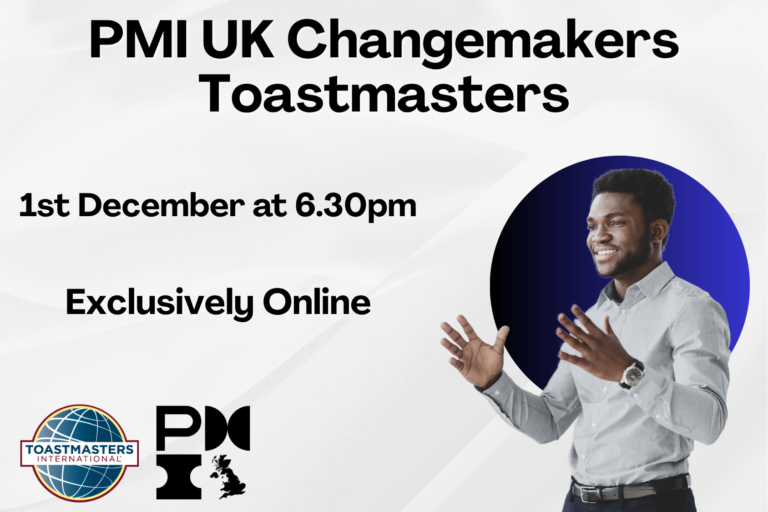
PMI UK Changemakers will give you the skills and confidence you need to effectively express yourself in any situation. Public speaking is a key project management skill and Changemakers is an efficient, enjoyable and affordable way of gaining great communication and leadership skills. By learning to effectively formulate and express your ideas, you open an entirely new world of possibilities. You’ll be more persuasive and confident when giving presentations and you’ll improve your one-on-one dealings with others.
-
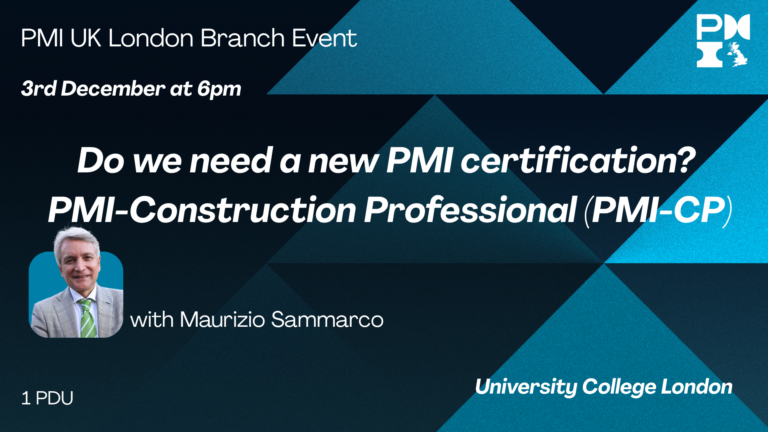
The session will also examine the certification pathway, eligibility requirements, and potential career benefits for construction professionals.
Whether you are an experienced project manager, an emerging construction professional, or a student considering a career in construction project management, this session will help you understand whether PMI-CP could be the right next step in your professional development.
Join us for an interactive discussion on the evolving competencies required to deliver successful construction projects and the role of professional certifications in shaping the future of the industry.
-
The General Meeting #2/2026 is called to submit to you the following
SPECIAL RESOLUTION
In order to align the PMI UK Chapter’s governance framework with the evolving PMI Guidelines, to ensure continued alignment with PMI policies and operational requirements, and reflect the current operational and membership arrangements of the PMI UK Chapter, the Members hereby approve and adopt a General Revision (Revision 4) of the Articles of Association.
-
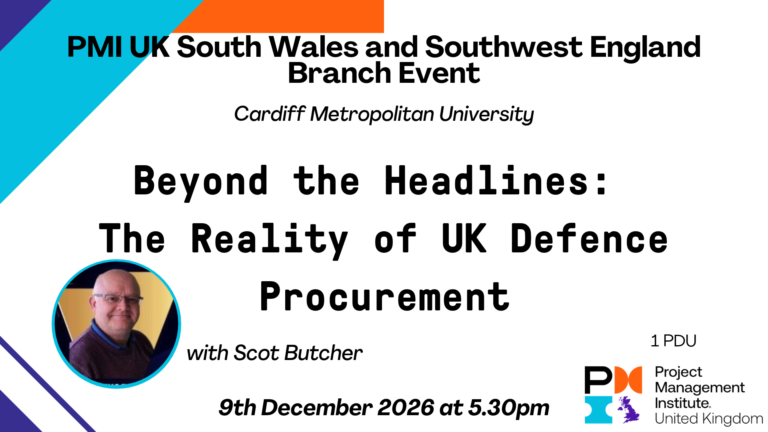
If you read the UK press, the UK has an almost exclusively poor record on defence procurement and, seemingly, the larger the programme the worse the performance.
Based on over 30 years working on major defence projects in the air and submarine sectors, Scot will unpick this premise and show that, while it’s not all good, it’s not all bad either. Using real examples (potentially anonymised to protect individuals and security), Scot will identify areas of continued weakness and ongoing strength. Rather than make this a one-way presentation, Scot would welcome a discussion on how we might overcome the former and build on the latter.
The four threads that Scot will pull on are:
- Entry-ism: Starting projects on the wrong footing
- Governance and decision making: both internal and external to the projects
- Lack of consistent structure and formality in the way we manage projects
- Change and change management
-
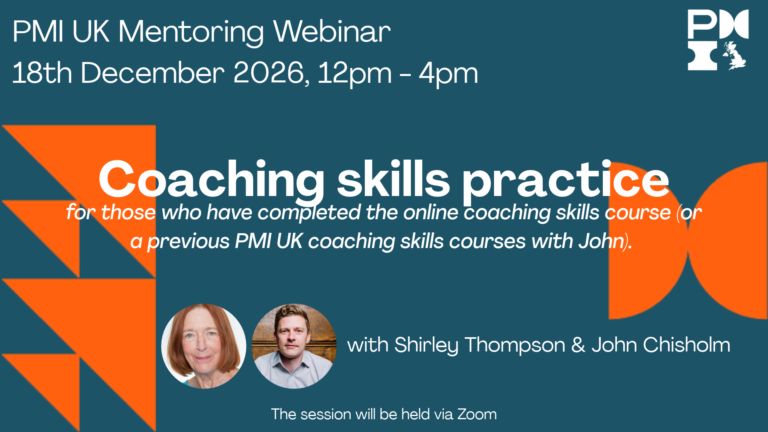
🌟 Are you a PMI UK mentor (or an aspiring one?)
Join us for the PMI UK Mentoring-led Event – an inspiring opportunity to connect with experienced project professionals and fellow members who are passionate about professional development.
This event will support you to get feedback on your coaching skills used in mentoring, offering insights into how mentors and mentees can build meaningful relationships to achieve aims.
All welcome 12-12.30 for networking, Q&A, review of the course etc.
Practice is for PMI UK members, starts at 12,30 and will need your undivided attention. Please commit at least to one practice session (12,30-2pm), but ideally to the second as well (2.30-4)
(Please register early to complete the course prior to 18th December)
January 2027
-
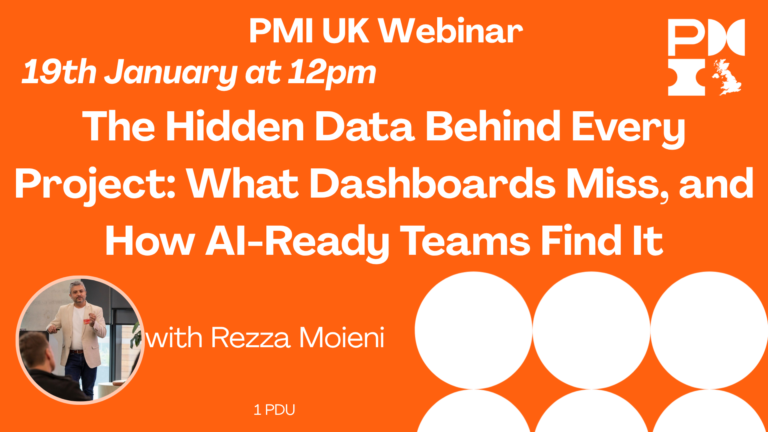
Drawing on real-world experience leading AI and technology teams, developing the Atlas platform, and researching human-centred innovation, Rezza demonstrates why these often-overlooked factors are stronger predictors of project outcomes than traditional metrics alone.
Attendees will discover how artificial intelligence and data-driven approaches can help reveal these invisible signals, enabling project managers to identify risks earlier, strengthen collaboration, and make better decisions. The session also unpacks what AI readiness really means for a project team: the skills, trust, and culture that need to be in place before AI can be implemented well, and practical lessons from putting AI to work inside real teams. The future of project management is not just measuring projects better. It is measuring people better, ethically and responsibly.
-
We spend our days firefighting—reacting to issue after issue until we’re exhausted and our projects suffer. Your project will never be healthier than you are.
This session unpacks why protecting your own energy is one of the best investments you can make in your project. You’ll leave with practical ways to show up more intentionally in conversations and calls — and how that directly shapes trust, decisions, and outcomes.
When we take care of ourselves, we lead better. And when we lead better, our projects follow.

-
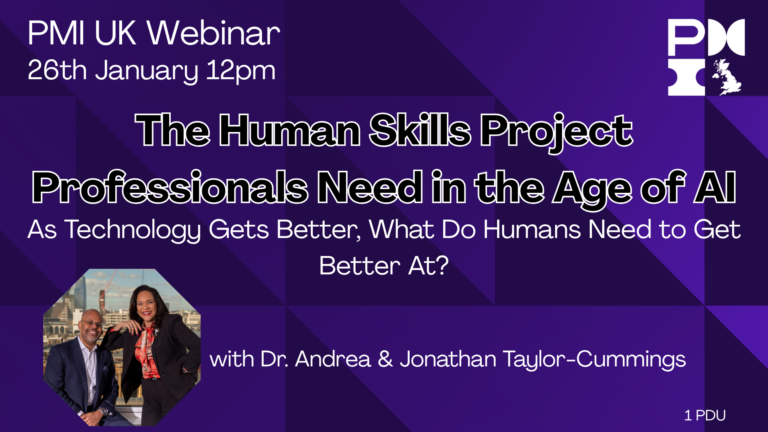
AI can rewrite your project plan overnight. But it can’t make a threatened stakeholder trust you, persuade a reluctant sponsor to speak honestly, or stop a team quietly resisting a change they never really bought into.
And when those human dynamics go unaddressed, faster technology can simply mean faster mistakes, more rework and greater costs.
As technology gets better, what do project professionals need to get better at?
This practical, thought-provoking webinar explores why Human Skills are becoming more valuable, not less, as AI reshapes project delivery. Drawing on behavioural research and more than three decades of organisational experience, Dr Andrea and Jonathan Taylor-Cummings will examine the capabilities that help project professionals turn technological advances into better decisions, stronger collaboration and meaningful project outcomes.
As AI accelerates analysis and delivery, project professionals need the judgement and relational skills to challenge assumptions, navigate resistance and ensure faster decisions lead to better outcomes, particularly when pressure is high and authority is limited.
Participants will be introduced to The 4 Habits® as a practical way to navigate automatic, defensive reactions, challenge assumptions and choose more constructive responses under pressure.
Through relatable examples and guided reflection, participants will identify one conversation or stakeholder relationship where a different response could reduce friction and improve delivery.
-
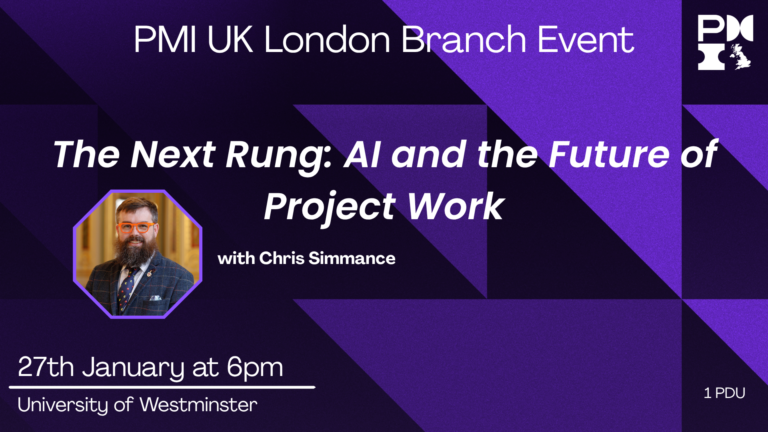
Every previous wave of automation had a next rung. Factory workers became service workers, service workers became knowledge workers, and the ladder held. This time the layer being automated is the one project professionals stand on: coordination, reporting, status-chasing, the orchestration work that sits between systems and people. And the rung above it is being automated at the same time.
Chris Simmance builds AI tools for a living and has written a book about what they do to careers, including his own clients’. In this session he sets out which project management tasks are exposed and which are durable, why the standard retraining advice fails this time, and a practical self-audit method for working out where you actually stand. Expect numbers rather than hype, and a fair amount of discomfort. Copies of The Next Rung will be available on the night.
February 2027
-
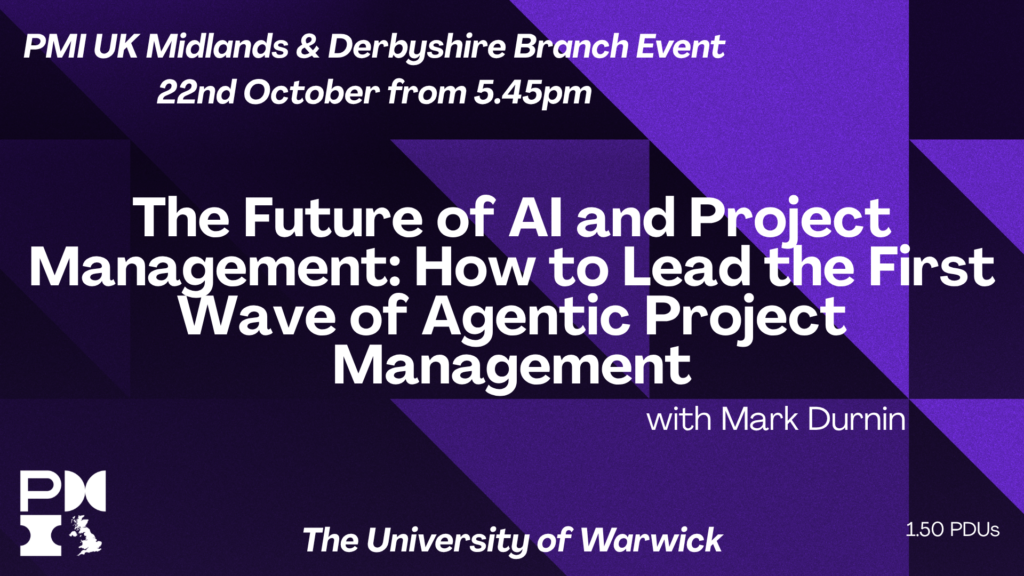
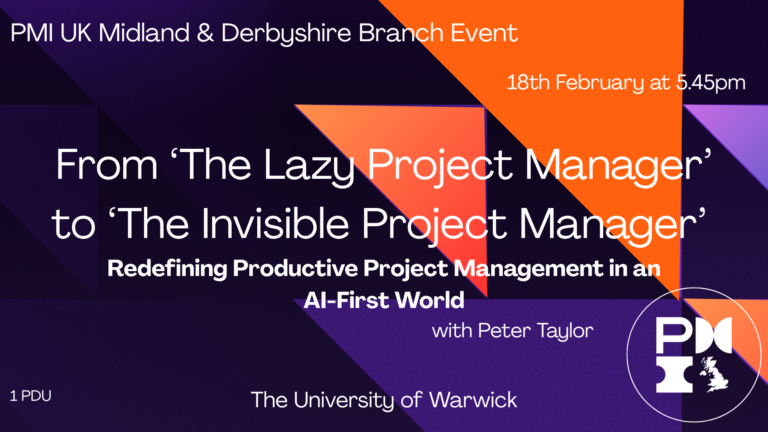
Thanks to the power of AI, the next generation of project delivery won’t be managed, it will be orchestrated, seamlessly, silently, invisibly. It just might be the end of project management as we know it and the beginning of something radically smarter, but will humans still be involved and, if so, how?
The presentation offers an essential and thought-provoking guide to evolution for forward-looking leaders, digital transformation strategists, and change agents who are planning for the long game.
Are you ready to disappear?
Expect a highly interactive and fun fuelled conversational session.
-
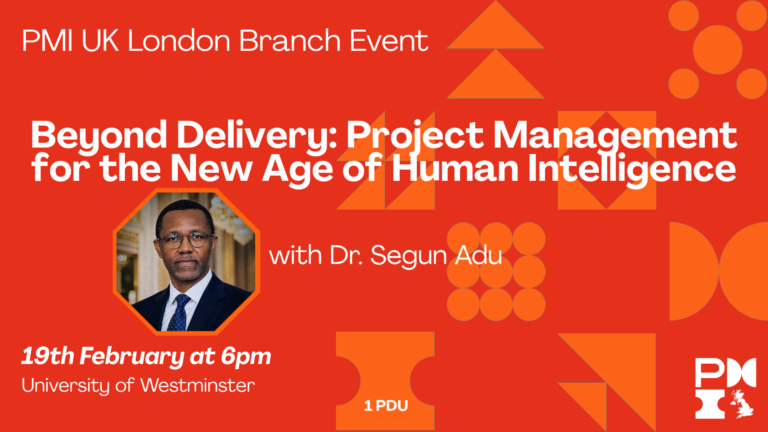
The current tidal wave of AI in everyday life has paradoxically presented an opportunity to reconsider our Human Intelligence. Artificial intelligence is changing how organisations plan, deliver, and govern projects. AI can summarise meetings, analyse risks, generate plans, monitor progress, draft communications, and identify patterns across complex project data. But as machines absorb more routine cognitive work, a deeper question has been emerging: what happens to human intelligence? And in unpicking that question, one wonders – What role does the project manager play?
This talk explores the proposition that project managers are uniquely positioned to lead the New Age of HI (Human Intelligence). Their role will not disappear as AI becomes more capable; it will become more consequential. Project managers will increasingly be responsible for the human capacities that determine whether intelligent systems create genuine value: judgment, sense-making, stakeholder trust, ethical decision-making, learning, and accountability.
No events match your search.