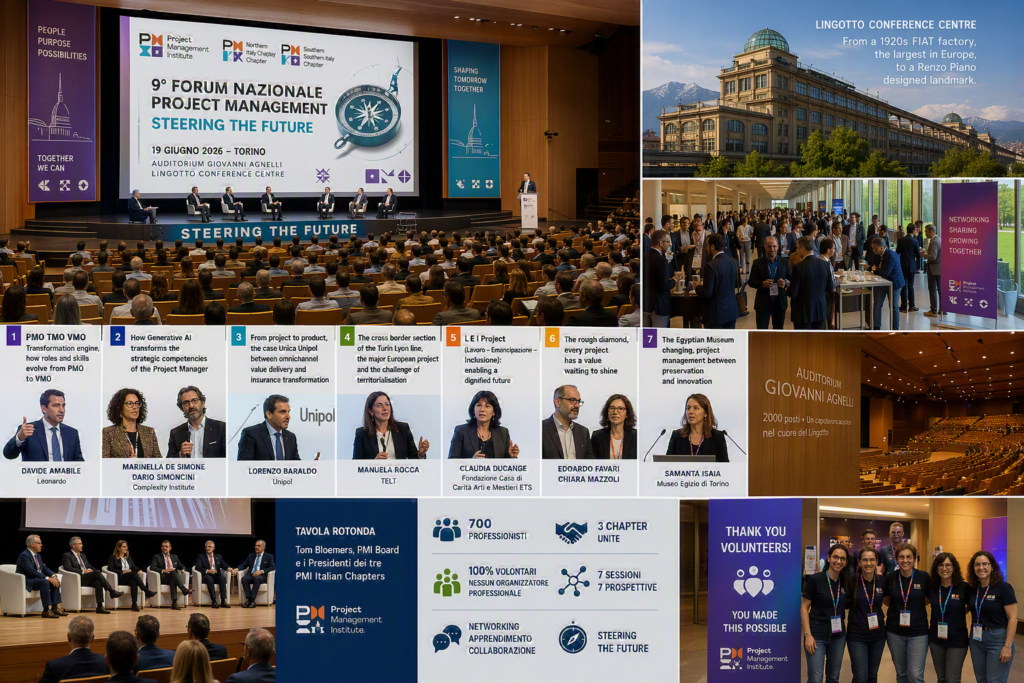
On 19 June 2026, around 700 project professionals gathered in Turin for the 9th National Project Management Forum, jointly organised by the three PMI Italian Chapters, Northern, Central and Southern Italy. The event took place at the Lingotto Conference Centre, part of the historic Lingotto building, originally a FIAT automobile factory built in the 1920s. At the time it was the largest factory in Europe. The site was closed in 1982 and later transformed through a design competition won by architect Renzo Piano in 1980. His redevelopment turned the industrial landmark into a multifunctional centre that now includes offices, a hotel, a shopping centre and the conference facilities.The Forum was hosted in the Auditorium Giovanni Agnelli, a large modular hall with a capacity of around 2000 seats, named after the founder of FIAT and widely regarded as an acoustic landmark within the complex.
The theme of the day was Steering the Future, with a central focus on the evolving identity of the Project Manager as a professional capable of guiding organisations through transformation, innovation and increasing complexity. The event explored this theme through a series of keynote presentations delivered by senior leaders from industry, academia, public institutions and the social sector.
A distinctive feature of the Forum was its design. There were no professional conference project managers and no professional presenters or moderators. All introductions, transitions and closing remarks were delivered by volunteers and board members from the three PMI Italian Chapters.
This created a strong sense of ownership, authenticity and community engagement, and also represented an important lesson in how large professional events can be successfully delivered through volunteer leadership. The format also encouraged extensive networking during breaks and the lunch session, which became an integral part of the learning experience.
The day opened with the session “PMO TMO VMO, Transformation engine, how roles and skills evolve from PMO to VMO”. The speaker was Davide Amabile, Senior Vice President Transformation Platform at Leonardo. He leads the governance of the company transformation roadmap, ensuring alignment between digital and cultural change initiatives and value creation across the organisation. He holds a degree in Electronic Engineering and a Master in Innovation Management.
His presentation explored the increasing “projectification” of organisations, where more and more work is structured through projects in order to deliver strategy, innovation and operational improvement. In this context, traditional Project Management Offices are evolving into Transformation Management Offices, with a broader mandate to connect strategic vision with execution across programmes of change. The discussion further extended towards the concept of a Value Management Office, focused on ensuring that transformation initiatives deliver measurable value over time. The session provided a structured view of how organisations can evolve their governance models to better support continuous transformation in an AI driven and highly digital environment
The second session focused on Artificial Intelligence under the title “How Generative AI transforms the strategic competencies of the Project Manager”. The speakers were Marinella De Simone and Dario Simoncini from the Complexity Institute.
Marinella De Simone is an economist, consultant and trainer, founder and CEO of Texture Srl. She is President and Scientific Director of the Complexity Institute, coordinates the Master in Complexity Management and teaches at the Italian National School of Administration. Her work focuses on learning processes, communication, conflict management and complex systems, integrating management practice with ethical and systemic perspectives.
Dario Simoncini graduated with honours in Economics and Commerce and completed advanced studies at Christ’s College Cambridge. He is a university lecturer at the University Gabriele d’Annunzio of Chieti Pescara and at the Italian National School of Administration. He is Founder and Vice President of the Complexity Institute and author of several publications on organisational complexity, knowledge and change.
Their joint presentation described Generative AI not simply as a technological tool but as a cognitive and cultural shift that is redefining how project managers think, decide and communicate. They emphasised that working with GenAI requires a new mindset capable of operating in uncertain and interconnected systems, where decisions are distributed across human and artificial agents. Complex thinking was presented as a strategic competence, enabling professionals to work with ambiguity, interdependence and dynamic environments. The Project Manager of the future was described not only as a coordinator of processes but as a designer of cognitive systems capable of co evolving with artificial intelligence.
The third session addressed Product Management with the presentation “From project to product, the case Unica Unipol between omnichannel value delivery and insurance transformation”. The speaker was Lorenzo Baraldo, Head of Digital Channels at Unipol. His career has spanned major transformations in the insurance sector, moving from data driven models to digital ecosystems and product centric approaches.
His presentation illustrated how organisations are increasingly moving from project based delivery models to product based operating models. Using the Unica Unipol case study, he showed how strategy, delivery processes and customer experience can be integrated to generate continuous value. The discussion highlighted the growing interaction between project and product management and the need for professionals capable of operating in evolving digital ecosystems where value is no longer delivered once but continuously developed.
The fourth session focused on megaprojects with the presentation “The cross border section of the Turin Lyon line, the major European project and the challenge of territorialisation.” The speaker was Manuela Rocca, civil engineer and Deputy General Director for Italy at TELT, also responsible for general affairs, environment, safety and sustainability.
Her presentation examined the Turin Lyon high speed rail project as a case study of complex European infrastructure development. She highlighted the importance of governance structures and stakeholder engagement in managing such large-scale initiatives. A particular focus was placed on the comparison between Italian and French governance models and the role of institutional dialogue in improving decision making quality and project outcomes. The session illustrated how megaprojects require not only technical excellence but also sustained political, institutional and social coordination.
The fifth session explored Social Impact through the presentation “L E I Project, (Lavoro = Work, Emancipazione = Empowerment, Inclusione = Inclusion): enabling a dignified future”. The speaker was Claudia Ducange, project management expert with over 25 years of experience in the third sector and coordinator of penal area initiatives at the Fondazione Casa di Carità Arti e Mestieri ETS.
Her presentation described the L E I project, launched in 2017 in the Turin prison Lorusso and Cutugno, aimed at addressing the “double punishment” experienced by incarcerated women, combining imprisonment with social exclusion. The initiative is based on a structured integrated pathway that includes orientation, soft skills development, financial education, vocational training and employment placement in partner cooperatives both inside and outside the prison system.
The project is supported by a strong governance structure including a steering committee, methodological supervision and a shared data platform. Since its inception it has supported over 210 women, demonstrating measurable improvements in skills and employability. The presentation highlighted how structured project management approaches can generate systemic and sustainable social impact when supported by strong partnerships and clear governance.
The sixth session focused on Sustainability under the title “The rough diamond, every project has a value waiting to shine.” The speakers were Edoardo Favari and Chiara Mazzoli.
Edoardo Favari holds a PhD and multiple PMI certifications including PMP and PMI ACP. He is Adjunct Professor of Project Management at Politecnico di Milano and IE Business School Madrid, Senior PMO Manager at Capgemini Engineering and contributor to the PMBOK Guide Eighth Edition development team. He is also a member of the PMI Sustainability Outreach Committee, working on the integration of sustainability principles into project management practice.
Chiara Mazzoli is Senior Director at Chiesi Farmaceutici, leading PFAS programmes and R and D sustainability projects. With more than twenty years of experience in pharmaceutical R and D, she has developed strong expertise in project governance and sustainable innovation. She holds PMP Scrum Master and Green Project Management certifications and is active in mentoring young women in STEM fields.
Their presentation explored what it means to integrate sustainability into project management beyond symbolic or compliance driven approaches. Edoardo provided a strategic framing of sustainability, clarifying common misconceptions. Chiara presented practical applications from the pharmaceutical sector, including the use of P5 Analysis to strengthen governance, accountability and impact measurement. The session demonstrated how sustainability is becoming a core dimension of project decision making, combining strategic vision with operational implementation.
The seventh and final thematic session addressed Change Management through the presentation “The Egyptian Museum changing, project management between preservation and innovation.” The speaker was Samanta Isaia, General Director of the Egyptian Museum of Turin.
She holds a degree in Political Science from the University of Turin and has extensive experience in both private and public sectors. After working in the organising committee of the Turin 2006 Winter Olympics, she joined the Egyptian Museum Foundation in 2006 and became General Director in 2017. She now oversees all organisational, administrative, financial and strategic aspects of one of the most important archaeological museums in the world.
Her presentation explored the complexity of managing transformation in a cultural institution that preserves 4000 years of history. She described how the museum must balance preservation, research, innovation and financial sustainability. In this context, the project manager becomes a mediator between strategic vision, regulatory constraints and organisational change. The session highlighted the realities and tensions of transformation, showing that even highly constrained environments require structured project management to enable meaningful change.
The Forum concluded with a round table discussion featuring Tom Bloemers from the PMI Board and the three Presidents of the Italian Chapters. The discussion synthesised the key themes of the day, reinforcing the importance of cross sector collaboration and the evolving role of the project profession.
Why attending this Forum matters for the PMI UK Chapter
The participation of two Board members from the PMI UK Chapter, myself as Chapter President and Ariadna Cruz Groberio as Director of Marketing, provided the PMI UK Chapter with direct strategic exposure to how large scale interchapter collaboration is designed, delivered and experienced in practice. The Forum offered an opportunity to engage closely with the leadership teams of the three Italian Chapters and to observe first hand a mature example of cross chapter cooperation within the PMI ecosystem. The presentations, primarily in Italian, remained accessible for us and enabled meaningful engagement with both content and participants.
The key value for the PMI UK Chapter is not only the breadth of technical and strategic content presented, but the depth of interaction with Chapter leaders, volunteers and board members from different regions. These exchanges create an important relational bridge that supports stronger interchapter alignment and open pathways to future collaboration initiatives across PMI communities internationally.
A particularly relevant organisational insight for the PMI UK Chapter is the deliberate choice to design and deliver the entire event without professional conference organisers or external presenters. The Forum has been fully executed by volunteers from the three Italian Chapters, demonstrating a high level of maturity, commitment and shared ownership. This model provides a concrete reference point for our Chapter, showing that large scale, high quality professional events can be successfully delivered through volunteer leadership when supported by clear structure, coordination and engagement. It also reinforces the strength of the PMI volunteer model as a core driver of community identity and impact.
Equally important is the event format itself. The structure combines plenary sessions, thematic diversity and intentionally designed networking time, creating a balanced environment where knowledge sharing and relationship building are equally prioritised. The pauses and lunch sessions are not peripheral elements but integral parts of the programme design, enabling cross sector dialogue and informal exchange that significantly enrich the overall experience.
Overall, the Forum provided the PMI UK Chapter with valuable insights into alternative models of chapter collaboration, event delivery and community engagement. These observations offer practical input for future Chapter initiatives and strengthen the foundation for more structured international cooperation within the PMI network.
Franco Guarrella
President PMI UK Chapter