
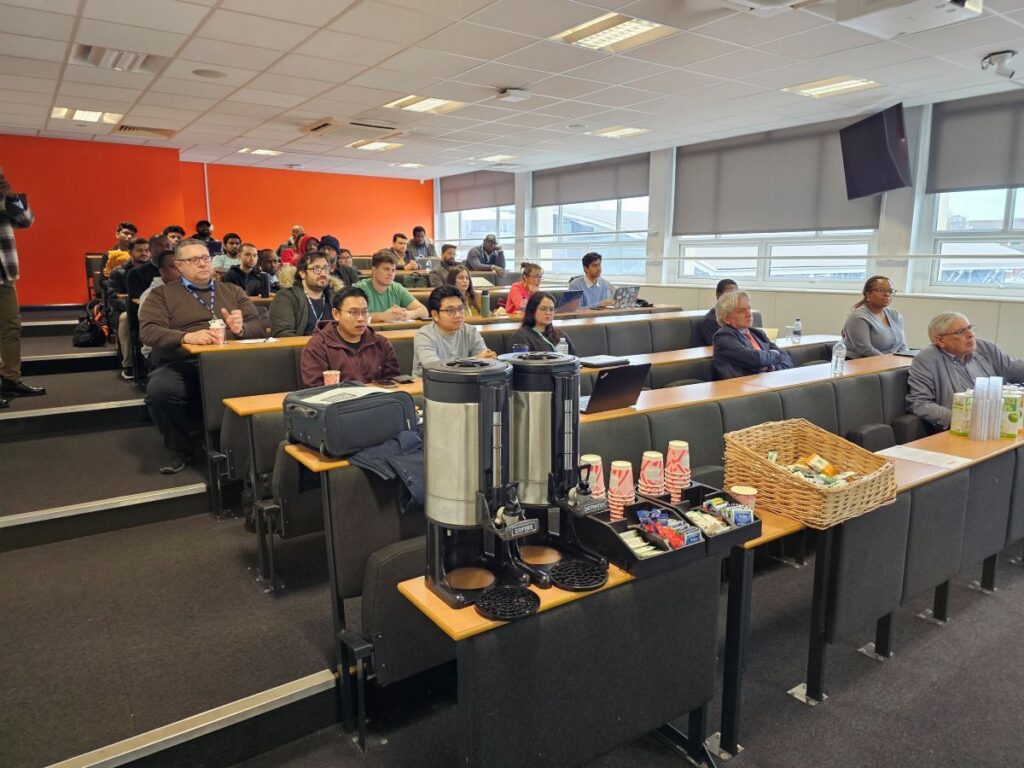
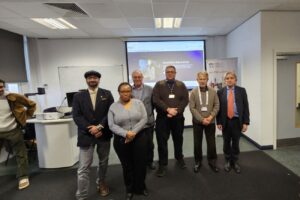
On 18 February 2026, the PMI UK Chapter delivered a highly successful academic engagement event at Liverpool John Moores University within the School of Engineering and Built Environment. Organised in collaboration with Dr Dimitrios Paraskevadakis, the session brought together students, lecturers and practitioners for a structured exploration of professional standards, certification pathways and responsible leadership in project management. Participation was strong, discussion was substantive, and feedback at the close of the event confirmed that the initiative had fully achieved its intended objectives.
Dr Dimitrios Paraskevadakis, Senior Lecturer and Programme Leader for the MSc in International Transport, Trade and Logistics, opened the event. Based at the Liverpool Logistics, Offshore and Marine Research Institute, he provides academic leadership in areas integrating transport systems, international trade, maritime operations and logistics strategy. His research and teaching sit at the interface between infrastructure development and global supply chain management. By inviting the PMI UK Chapter to engage directly with students and academic colleagues, he reinforced the importance of aligning postgraduate education with internationally recognised professional frameworks.
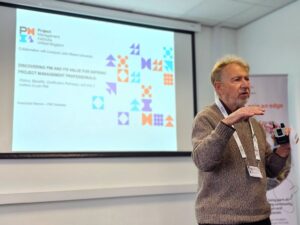
Franco Guarrella, President of the PMI UK Chapter, introduced the Chapter and contextualised its role within the global Project Management Institute. He outlined the Institute’s mission to advance the project management profession through standards, certifications, research and community building. His remarks emphasised structured competence development, ethical accountability and the value of globally portable credentials, particularly for students preparing to enter increasingly complex project-based environments.
The first part of the session was dedicated to the presentation by Assadullah Memon, entitled Discovering PMI and Its Value for Aspiring Project Management Professionals. Assad is a certified Project Management Professional and ITIL practitioner, as well as a Fellow of the Higher Education Academy. With approximately twenty years of international experience, he has led business transformation, operational excellence and organisational change initiatives across diverse sectors, including technology-enabled environments and service operations
Currently pursuing doctoral research in project management at the University of Manchester, Assad integrates rigorous academic inquiry with extensive practical experience. His research engagement strengthens his perspective on how standards, methodologies and certifications translate into measurable organisational value. As an active member of the PMI UK Chapter North-West Branch, he contributes to regional professional development initiatives while maintaining strong links with the broader PMI community.
In his presentation, he introduced PMI as the world’s leading professional association for project managers and explained its global architecture, including standards development, credentialing systems and knowledge dissemination. He articulated how PMI certifications provide structured validation of competence across experience levels, creating a transparent benchmark for employers and clients. He further highlighted the benefits of PMI membership, including access to a global professional network, curated learning resources, thought leadership publications and continuing professional development opportunities.
Assad presented the PMI UK Chapter, its activities, and its strategic objective to strengthen collaboration with universities and support students and young professionals in developing their project management skills and career prospects.
Assad emphasised that certification is not merely a credential but a disciplined process of competence validation and lifelong learning. He discussed how alignment with PMI standards enhances governance maturity within organisations and improves consistency in delivery performance. Drawing on his own career trajectory, he illustrated how professional accreditation can accelerate progression, strengthen credibility in international contexts and facilitate mobility across sectors. His contribution resonated strongly with students seeking clarity on how to bridge academic study with professional practice.
The construction dimension of project management was then addressed by Yvette Dimiri and Professor Maurizio Sammarco. Yvette Dimiri serves as PMI Partner Success Manager for Construction across Europe, supporting adoption of sector-specific standards. Professor Maurizio Sammarco is Associate Professor in Management for the MSc in Construction Economics and Management at the Bartlett School of Sustainable Construction, University College London, and also acts as Construction Ambassador for the PMI UK Chapter and Chair of its Construction Specific Interest Group.
Their presentation introduced the PMI Construction Professional certification, PMI-CP, as a specialised pathway designed to prepare construction project managers to lead, plan and manage contracts effectively. They explained that the certification equips professionals to navigate sector-specific challenges while remaining relevant in an evolving industry landscape. The framework strengthens leadership capability, enhances communication and commitment-based management skills, and promotes adaptability to innovation and sustainability demands. By cultivating forward-looking competencies, PMI-CP supports construction professionals in future-proofing their careers within a dynamic built environment.
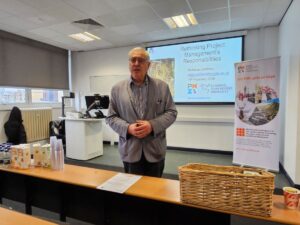
The keynote address was delivered by Dr Nicholas Lambrou, Emeritus Fellow at the University of Westminster. Beginning his career in information technology before moving into lifelong academic leadership, he has managed complex institutional projects internationally, including initiatives to establish universities in Oman, India and Uzbekistan. His experience reflects deep engagement with strategic oversight and organisational development.
In his presentation on Responsible Project Leadership, Dr Lambrou challenged a persistent assumption within the profession. He noted that project managers often argue they are constrained by predefined terms of reference and were not involved in shaping the original scope. This position, he suggested, creates an artificial divide between project conception and execution, implicitly absolving practitioners from questioning flawed assumptions embedded in the initial definition. Accepting scope as untouchable simply because it was defined “pre-project” risks perpetuating strategic errors under the cover of procedural compliance.
Dr Lambrou argued that if the classical definition of project management permits defective projects to proceed unchecked, then the definition itself requires reconsideration. Limiting accountability to delivery performance, time, cost and scope, without interrogating the validity of objectives reflects a narrow and outdated view of the discipline. Shifting blame to programme or portfolio levels does not resolve the issue; it merely relocates it. Responsibility cannot be diluted by hierarchy.
Central to his thesis was the assertion that project management is responsible for everything manmade. Every system, structure and institution originates as a project. If this is so, the profession cannot confine itself to technical execution. With influence comes responsibility. Project managers operate at the intersection of strategy, governance and stakeholder impact, and therefore carry an obligation to challenge misalignment, escalate concerns and act when ethical or strategic flaws are evident.
He called for a redefinition of the profession’s core tenets, integrating strategy, leadership, ethics and alignment with sustainable development goals into mainstream practice. Responsible project management, in his view, extends beyond efficient delivery to principled stewardship. If everything manmade results from projects, then responsible leadership is not optional but fundamental to the identity of the profession.
The event concluded with closing remarks and thanks from Dr Paraskevadakis and Franco Guarrella. The high level of engagement, the depth of discussion and the positive reaction from students and faculty confirmed the success of the initiative. The collaboration marked a significant step in strengthening ties between Liverpool John Moores University and the PMI UK Chapter, reinforcing a shared commitment to advancing professional standards and responsible leadership in project management.
Franco Guarrella
PMI UK Chapter President