

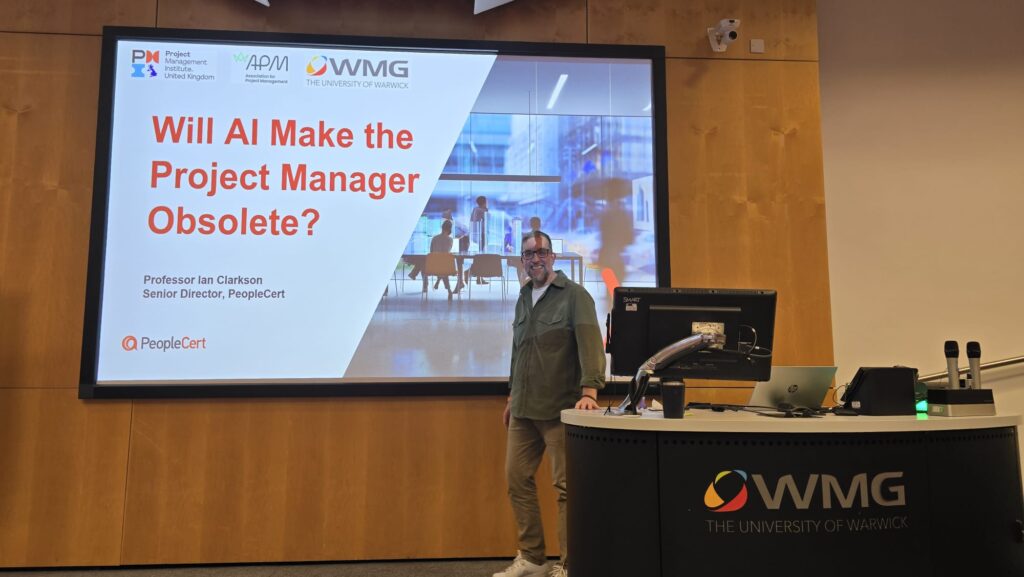
The International Manufacturing Centre at the University of Warwick provided a fitting and highly symbolic setting for a PMI UK Chapter event held on 26 March 2026. Located within one of the UK’s most respected academic institutions, the venue, the International Manufacturing Centre, a key facility located at the hearth of the WMG’s Campus operations, offered more than a physical space for discussion, it provided an environment that embodies the very themes that project professionals face today: innovation, transformation, collaboration, and delivery. The University of Warwick has long stood as a centre of academic excellence and forward-thinking research, attracting global partnerships and contributing to the development of skills and knowledge that shape modern industries. Hosting a Project Management event within this environment served as a powerful reminder that the future of the profession is inseparable from the future of research, technology, and industrial development.
At the heart of the evening was WMG, Warwick Manufacturing Group, internationally recognised for its ability to bridge the gap between academia and industry. WMG is not simply a university department, but a global ecosystem of research, education, and industrial engagement that supports organisations in developing advanced manufacturing capabilities, digital transformation, supply chain innovation, and sustainable engineering. Its work reflects the reality that progress in modern industry is no longer driven by isolated breakthroughs, but by collaborative networks that connect knowledge, experimentation, and real-world implementation. By hosting the PMI UK Chapter and APM joint event, WMG offered an inspiring example of how the right setting can elevate a professional gathering into something more meaningful, a shared platform for reflection on how the discipline of Project Management must evolve in an age shaped by artificial intelligence.
The International Manufacturing Centre itself reinforced this message. It is a space designed for exchange, for ideas, and for professional learning. Its modern facilities and welcoming environment created the right atmosphere for a discussion not only about technology, but about leadership, human judgement, and the role of professionals in guiding change. In many ways, it was the perfect venue for an event focused on one of the most pressing questions facing today’s project community: will artificial intelligence make the project manager obsolete?
The evening also highlighted a truth that is sometimes overlooked in discussions about innovation. Research generates knowledge, engineering develops solutions, but it is Project Management that ensures these solutions are delivered effectively and reach the organisations, communities, and markets that need them. This is the crucial bridge between invention and impact. It is easy to celebrate technological advancement, but it is far harder to deliver it in practice, within real constraints, within real organisations, with real people and real risks. Project Management is the discipline that converts innovation into outcomes, turning potential into measurable value. Behind every successful transformation, every new technology deployed, and every large-scale change initiative, there is a project or programme being managed with discipline, clarity, and purpose.
This philosophy aligns strongly with the mission of the Project Management Institute and of the PMI UK Chapter. PMI exists not simply to promote certification or professional standards, but to support the development of professionals at every stage of their careers and to foster collaboration between academia, industry, and practitioners. The Warwick event demonstrated this mission in action, bringing together individuals from different professional backgrounds to explore how emerging technologies are reshaping the discipline, and what that means for the future identity of the project profession.
The event was organised in coordination with APM, WMG, and the PMI UK Chapter Midlands and Derbyshire Branch, chaired by Nigel Smith. The collaboration itself reflected a strong message: the challenges ahead are too complex for any single institution or professional body to address alone. The future of project delivery will require a shared effort across professional organisations, universities, and the industries that depend on projects for their survival and growth. The partnership between PMI and APM for this event was therefore more than administrative cooperation, it was a clear sign of maturity and shared purpose in the UK project community.
The evening began with almost an hour of networking in a large cafeteria area at the University. This informal session, supported with food and drinks, allowed attendees to reconnect, exchange perspectives, and build new professional relationships. The atmosphere was lively, open, and welcoming, demonstrating how in-person events remain essential in a profession built on communication and collaboration. While virtual platforms have enabled learning and engagement across distances, they rarely replicate the depth of conversation and trust-building that emerges naturally when professionals meet face to face. The networking session therefore played an important role in reinforcing one of the PMI UK Chapter’s key objectives: building a strong and connected local community of project professionals.
After the networking session, attendees moved into a large and comfortable theatre where the main event took place. The scale of the space reflected the high level of interest in the topic, and the energy in the room suggested that the question of AI’s impact on the profession is not a distant theoretical debate, but a real concern and opportunity that project managers are already confronting in their daily work.
The introduction to the event was delivered by Professor Parveen Kaur Samra, Associate Dean (WMG Postgraduate Education) of the University, who welcomed attendees and highlighted the importance of hosting such a discussion within the University of Warwick environment. The opening remarks reinforced the idea that universities have a responsibility not only to educate, but to act as convening platforms where practitioners and researchers can challenge assumptions and exchange insights. This was followed by remarks from Roger Garrini, APM Midlands Corporate Lead, who briefly acknowledged the support of APM and reinforced the value of professional bodies working together to strengthen the project discipline across the UK.
Franco Guarrella, President of the PMI UK Chapter, then welcomed the audience. In his address, he referenced the importance of PMI’s mission and expressed a clear wish to increase the number of in-person events, strengthening professional networks and supporting community growth. He also praised Nigel Smith, Chair of the PMI UK Chapter Branch Midlands and Derbyshire, recognising his key role in developing the relationship with the remarkable academic and industrial ecosystem present in the region. This acknowledgement reflected the importance of local leadership within PMI, and the reality that professional communities grow not through strategy documents alone, but through the commitment of individuals who invest time and energy into creating opportunities for connection and learning.
The main speaker of the evening was Professor Ian Clarkson, whose experience and reputation made him an ideal contributor to such a topic. Ian has over a quarter of a century of experience in project, programme and portfolio management, organisational change, and learning. His career includes advisory work with many organisations and industry bodies, including PMI, APM, and PeopleCert, and he is widely recognised for his involvement in shaping project management best practice. His professional focus is not limited to academic theory, but strongly rooted in practical delivery and organisational improvement. He is also passionate about encouraging the next generation of project professionals, an important message at a time when the profession is facing both technological disruption and shifting expectations about what project leaders must be able to do.
His session was framed around a central question: with the increasing use of AI, how is the project profession being impacted by it? Rather than treating AI as a distant future development, the discussion positioned it as a present reality, already influencing the way project teams plan, execute, monitor, and make decisions. The session was highly interactive and deliberately designed to engage the audience not only as listeners, but as participants. Attendees were encouraged to use their phones and devices to contribute to live research during the event, creating an experience that reflected the very digital environment being discussed. This element of real-time engagement added both energy and relevance, demonstrating that the future of learning itself is becoming more collaborative, data-driven, and dynamic.
A key strength of the presentation was that it did not jump directly into AI tools or futuristic predictions. Instead, Professor Clarkson took the audience back to first principles by exploring what a project actually is, and what it is not. This foundational discussion proved particularly valuable, as many organisations continue to label routine operational work as projects, creating confusion, misalignment, and unrealistic expectations. By clarifying the definition of a project, he established a clear basis for understanding where AI may add value, and where it may not.
From there, the session examined why projects fail, acknowledging openly that many projects do indeed fall short of expectations. This point resonated strongly with the audience, as project failure remains one of the most persistent challenges across industries. Projects fail not only because of poor planning, but because of weak stakeholder engagement, unclear objectives, ineffective governance, unrealistic schedules, inadequate risk management, and resistance to change. These factors are deeply human and organisational in nature, and this reality set the stage for a more nuanced conversation about the role AI could play.
Professor Clarkson guided the audience through an exploration of how AI may influence the project profession, and whether it could ultimately make the project manager obsolete. The discussion was balanced and thought-provoking. AI can clearly enhance many aspects of delivery, such as analysing large datasets, identifying patterns in project performance, supporting forecasting, automating reporting, improving scheduling accuracy, and providing early warnings of risk indicators. AI can help project teams move faster, process information more effectively, and potentially reduce the administrative burden that many project managers face. It can also support decision-making by offering scenario modelling and predictive insights, particularly in complex environments where uncertainty is high.
However, the session also highlighted that project success depends on far more than information processing. Leadership, communication, negotiation, emotional intelligence, ethical judgement, and the ability to influence stakeholders remain essential. Even the most advanced AI system cannot fully replace the trust-based relationships that project managers must build across teams, sponsors, suppliers, and customers. AI can recommend, analyse, and automate, but it cannot genuinely take accountability, nor can it lead people through uncertainty in the way a skilled project professional can.
The session therefore encouraged participants to think critically about the future role of the project manager, not as a disappearing profession, but as an evolving one. Rather than replacing project managers, AI is likely to change the focus of the role. Routine administrative work may increasingly be automated, while the human aspects of delivery will become even more central. In that sense, AI may not eliminate project managers, but it may raise the standards of what is expected from them. The project manager of the future will need to be more strategic, more commercially aware, more technologically literate, and more capable of navigating organisational complexity.
A key benefit for attendees was the clarity gained from revisiting fundamental principles. Participants left with a stronger understanding of what constitutes a true project, why projects go wrong, and where AI can realistically support improved outcomes. They also experienced a new way of collaborative learning through the live research activities during the session, reinforcing that the profession itself is moving toward more interactive, data-informed practices.
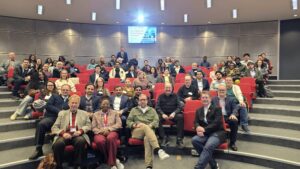
By the end of the evening, the audience had not only explored whether AI could replace the project manager, but had also reflected on the deeper question of what makes Project Management valuable in the first place. The answer was clear throughout the discussions: project professionals create value not merely through process, but through leadership and delivery. AI may accelerate execution and enhance decision-making, but the responsibility for turning innovation into impact remains fundamentally human.
The PMI UK Chapter event at Warwick University on 26 March 2026 therefore achieved far more than a discussion about emerging technology. It strengthened professional community, reinforced the importance of collaboration between academia and industry, and provided a timely reminder that Project Management remains essential in a world increasingly shaped by innovation. WMG and the University of Warwick offered not only an inspiring venue, but a powerful example of how ideas are transformed into practical solutions. In such an environment, the question was not whether project managers will become obsolete, but how they will adapt, evolve, and continue to lead the delivery of change.
If the future belongs to artificial intelligence, it will still be delivered through projects. And projects, no matter how advanced the tools become, will continue to require professionals who can guide people, align stakeholders, manage uncertainty, and turn ambition into reality.
Franco Guarrella
President PMI UK Chapter