Events
Learn, meet and grow — online and near you.
Webinars, branch meetups and Toastmasters sessions. Almost everything is free.
October
-
Despite advances in programme management, governance and benefits management, well-designed programmes can still struggle to realise the value they were intended to create. Why?
This webinar explores whether part of the answer lies beyond methodologies and delivery frameworks, within the organisational conditions that shape behaviour, decision making and what becomes legitimate throughout programme delivery.
The session introduces the Behavioural Theory of Value Realisation, a practitioner-led perspective on how organisational conditions shape behaviour and influence whether intended value is ultimately realised.
Participants will leave with a different way of thinking about the gap between successful delivery and realised value, together with questions they can apply to their own programmes and organisations.
November
-
In a world of increasing uncertainty, project leaders need faster, better-informed decisions. Yet fragmented information, disconnected systems and manual reporting make it difficult to gain a clear view of projects and portfolios.
AI offers opportunities to identify emerging risks, anticipate delivery challenges, automate routine tasks and improve decision-making. However, without trusted data and connected processes, AI risks amplifying existing problems rather than solving them.
This session explores how organisations can progress from fragmented information to connected, automated and AI-powered project and portfolio management.
Using practical examples from the Microsoft ecosystem, we’ll demonstrate how existing technologies can create a single source of truth, strengthen visibility and governance, and unlock AI-driven insights to support smarter decisions and better delivery outcomes.
-
Help! Everyone is using AI. But what does that mean for project managers when AI produces different results? This session begins with the three most common applications of AI in projects, followed by research-based evidence on what drives project success. Looking ahead, AI will converge with other technologies, changing how projects are delivered. As the project environment changes, the role of the project manager must also adapt. Project professionals will spend less time collecting and reporting information and more time interpreting, analysing, and making decisions. Yet how do we ensure that project accountability remains a human responsibility? The session concludes by identifying the skills project managers will need to remain effective in this changing environment.
-
PMI UK Changemakers will give you the skills and confidence you need to effectively express yourself in any situation. Public speaking is a key project management skill and Changemakers is an efficient, enjoyable and affordable way of gaining great communication and leadership skills. By learning to effectively formulate and express your ideas, you open an entirely new world of possibilities. You’ll be more persuasive and confident when giving presentations and you’ll improve your one-on-one dealings with others.
-
Strategy rarely fails in the boardroom; it fails in the corridors, meetings and inboxes where leaders interpret, adjust and quietly block the call to action. This presentation tackles the most stubborn problem in enterprise change: how to actually get a reluctant organisation to move.
This session explores the political nature of organisations, the mechanics of mobilising a “volunteer army” of middle managers and below, and the quarterly cadence that turns strategy into delivered outcomes.
Participants leave with a working influence map of their own context, a designed first sprint they can run inside their organisation (or their client’s), and seven design principles for getting bottom-up change off the ground.
-
Technical skills get you hired. Power skills get you heard, trusted, and promoted.
In today’s complex project landscape, project and program managers are expected to lead without always having formal authority, managing stakeholders, navigating resistance, and driving decisions in environments that rarely stop to wait for clarity.
In this 60-minute webinar, Raquel Horta – coach, consultant, and author of Power Skills: The Human Edge in Project and Program Management – explores the skills every PM needs to increase their influence.
-
Join us to celebrate a year of learning, inspiring speakers, and connections across the Women in Projects Network. We’ll begin with a look back at 2026 and what’s ahead, hear Lily Satterthwaite’s keynote, From Strength to Strength, and then turn to Liz Hector’s practical reflection on setting your compass for 2027. We’ll finish by connecting with one another.
-
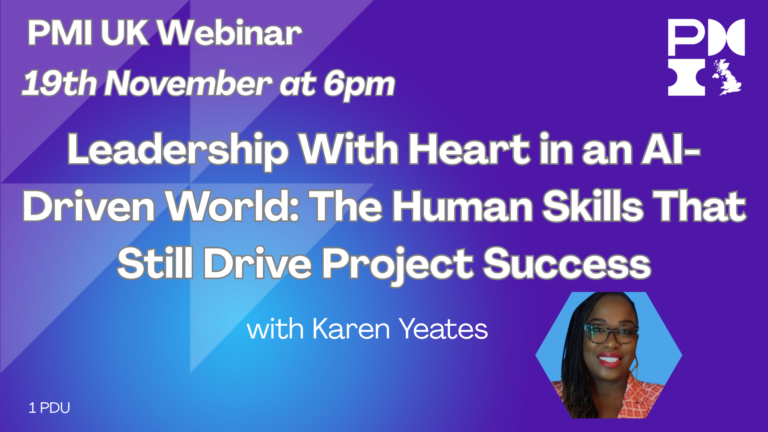
As artificial intelligence, automation, and digital transformation reshape the workplace, project leaders are navigating a new reality: increasing complexity, faster decision cycles, evolving stakeholder expectations, and growing pressure to deliver results. Yet amid rapid technological change, the most critical differentiator for project success remains deeply human. This engaging and practical session explores the role of emotional intelligence, empathy, communication, adaptability, and human-centered leadership in modern project environments. Participants will examine how emotional intelligence supports stronger stakeholder engagement, more effective communication, improved conflict navigation, resilient teams, and healthier leadership practices — particularly in environments influenced by AI, digital transformation, and continuous change.
Attendees will leave with actionable strategies to enhance their emotional intelligence, strengthen leadership effectiveness, and lead projects with greater confidence, influence, and human connection in an increasingly digital world.
January 2027
-
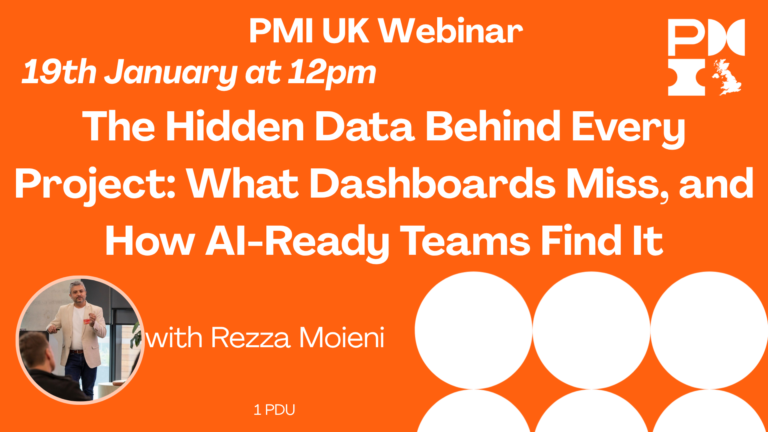
Drawing on real-world experience leading AI and technology teams, developing the Atlas platform, and researching human-centred innovation, Rezza demonstrates why these often-overlooked factors are stronger predictors of project outcomes than traditional metrics alone.
Attendees will discover how artificial intelligence and data-driven approaches can help reveal these invisible signals, enabling project managers to identify risks earlier, strengthen collaboration, and make better decisions. The session also unpacks what AI readiness really means for a project team: the skills, trust, and culture that need to be in place before AI can be implemented well, and practical lessons from putting AI to work inside real teams. The future of project management is not just measuring projects better. It is measuring people better, ethically and responsibly.
-
We spend our days firefighting—reacting to issue after issue until we’re exhausted and our projects suffer. Your project will never be healthier than you are.
This session unpacks why protecting your own energy is one of the best investments you can make in your project. You’ll leave with practical ways to show up more intentionally in conversations and calls — and how that directly shapes trust, decisions, and outcomes.
When we take care of ourselves, we lead better. And when we lead better, our projects follow.

No events match your search.