

Aberdeen occupies a distinctive position within the United Kingdom’s economic and academic landscape. Known as Europe’s energy capital, the city developed around the technical and managerial demands of the North Sea. Its universities have long supported this evolution. The University of Aberdeen, founded in 1495, contributed early advances in medicine, geology and engineering that later underpinned offshore exploration. In more recent decades, Robert Gordon University has established itself as a practice-oriented institution closely aligned with industry needs, recognised for producing graduates equipped for immediate professional responsibility.
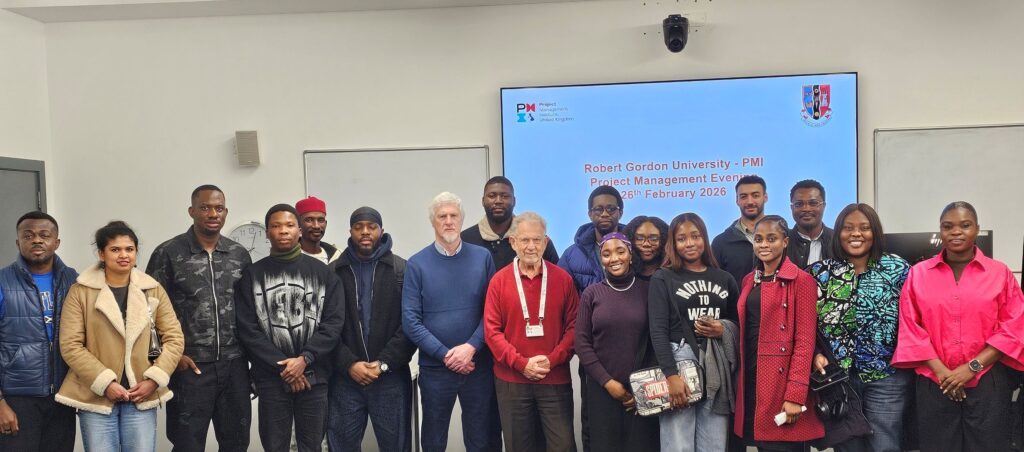
The relationship between academia and industry in Aberdeen is embedded in curriculum design, applied research and sustained interaction with practitioners. This context made Robert Gordon University an appropriate venue for the event organised on 26 February 2026 by the PMI UK Chapter North Scotland Branch. The choice was consistent with the Chapter’s policy of maintaining structured engagement with universities, ensuring that professional standards and academic development remain connected.
The session was organised in collaboration with Ahmed Aslam, lecturer in Project Management at Robert Gordon University. It was chaired by Paolo Monachello, Chair of the PMI UK Chapter North Scotland Branch, and opened by Franco Guarrella, President of the PMI UK Chapter. Students, academic staff and local practitioners attended for a focused workshop on the practical use of artificial intelligence tools in project work.
In his brief introduction, Franco Guarrella outlined the structure of the PMI UK Chapter and the role of its regional branches, highlighting their function in fostering local professional communities and maintaining active relationships with universities. He acknowledged the work carried out over the years within the North Scotland Branch with its former Chair Billy Grierson and welcomed the opportunity to engage with Robert Gordon University.
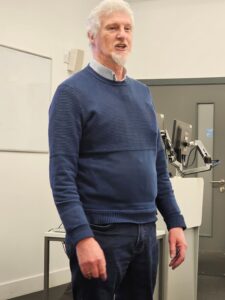 Paolo Monachello and Ahmed Aslam then introduced the speaker, Billy Grierson. With more than thirty years of experience in the chemical industry, including international roles with Ciba and BASF, Billy has developed practical insight into why projects fail in complex organisations and which structured tools and techniques can improve outcomes. A PMP accredited project manager and former Chair of the North Scotland Region of the PMI UK Chapter, he now works as an independent consultant through Perth Innovation, focusing on problem solving and innovation. His professional background provided a pragmatic framework for the evening’s topic.
The workshop itself was deliberately practical. Its central premise was straightforward, AI tools such as ChatGPT and Copilot can be effective, but only if the user formulates requests clearly. The objective was to demonstrate how to craft prompts that produce more reliable and relevant results.
Rather than presenting AI in abstract terms, the session concentrated on everyday application. Participants were introduced to the essentials of prompt crafting, including defining a clear objective, providing appropriate context, specifying constraints, and identifying the desired format of the output. The discussion showed how vague prompts tend to generate generic responses, whereas structured and precise prompts lead to outputs that better match the user’s needs.
Practical exercises formed a core part of the session. Through concrete examples, attendees observed how modifying a prompt by adding detail, clarifying audience or defining scope could significantly improve the usefulness of the response generated by the AI tool. Tasks relevant to project environments were considered, such as drafting communications, structuring summaries, generating initial risk lists or supporting preliminary analysis. The emphasis remained on assistance rather than replacement. AI was presented as a support tool capable of accelerating routine tasks and helping to structure thinking, while professional judgement and accountability remained central.
In the context of Aberdeen’s project-intensive economy, this balanced approach was appropriate. The region’s industrial base, historically centred on offshore oil and gas and increasingly engaged in renewable energy and transition initiatives, depends on disciplined project governance. Tools that enhance clarity and efficiency are relevant, provided they are applied within established frameworks of responsibility. Prompt engineering was therefore positioned as an additional competence within the project manager’s skill set.
Interaction during the session was constructive and the discussion remained grounded in realistic use cases rather than speculative projections.
 By the conclusion of the workshop, participants had engaged in hands-on exercises and received practical guidance intended to increase confidence in using AI systems in everyday work. The outcome was aligned with the aim of the session, to enable attendees to write clearer prompts and obtain more targeted outputs.
For the PMI UK Chapter North Scotland Branch, the event met its objectives. It reinforced collaboration with Robert Gordon University, offered students exposure to current professional practices, and provided practitioners with an opportunity to reflect on emerging tools in a structured academic setting. The partnership with Ahmed Aslam ensured coherence with the university’s project management programme, while the presence of branch and chapter leadership reflected the ongoing commitment to university engagement.
The setting of Robert Gordon University was integral to the initiative. As an institution known for its applied focus and strong links to industry, it provides a suitable platform for discussions at the intersection of technology and professional practice. In Aberdeen, where technical competence and effective project delivery remain central to economic activity, such engagement retains practical relevance.
The event did not seek to make expansive claims about artificial intelligence in project management. Instead, it addressed a specific and practical question, how to ask better questions of AI systems. Through a focused and application-oriented workshop, the PMI UK Chapter North Scotland Branch contributed to the gradual integration of new digital tools into established project management practice, within an academic environment closely connected to the professional realities of Aberdeen.
Franco Guarrella
President, PMI UK Chapter