

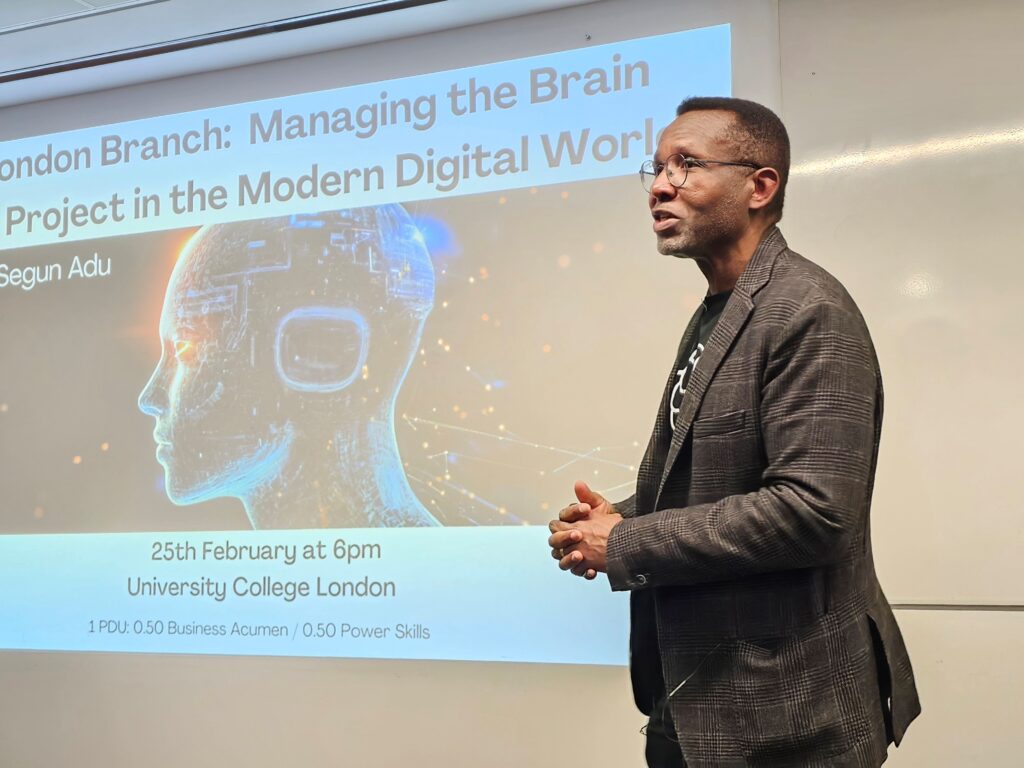
On 25 February 2026, the London Branch of the PMI UK Chapter organised an evening event at University College London, hosted by Prof Maurizio Sammarco, Associate Professor in Management for the MSc in Construction Economics and Management at the Bartlett School of Sustainable Construction, UCL, Construction Ambassador for the PMI UK Chapter and Chair of its Construction Specific Interest Group. The event brought together students, academics and project management professionals for a timely reflection on the evolving cognitive demands placed on practitioners in an increasingly digital environment.
 Franco Guarrella, President of the PMI UK Chapter, opened the evening by introducing the Chapter and positioning it within the global framework of the Project Management Institute. He explained the role of Branches as an operational cmponent of the Chapter, serving members locally while maintaining alignment with the wider professional body. Particular emphasis was placed on the contribution of volunteers, whose commitment ensures that professional development initiatives, networking opportunities and knowledge-sharing events are delivered effectively. He also reminded attendees that beyond technical learning, such gatherings serve a social function, strengthening the community of project management professionals who meet regularly, exchange ideas and build lasting professional relationships. The audience was invited to consider volunteering as an active way of shaping the profession’s future, before the floor was handed to Dr Segun Adu.
The session was delivered by Dr Segun Adu, cognitive trainer and founder of Smarter Brains GYM and Smarter CEO. He holds a Doctor of Business Administration from Henley Business School, where his doctoral research focused on emotional intelligence, cognitive psychology, neuroscience and behavioural science within the context of leadership competencies. His academic trajectory later extended into medical neuroscience, reflecting a deepening interest in the biological foundations of cognitive performance. A strong advocate for mental and cognitive awareness in the AI age, Dr Adu regularly delivers masterclasses at the London Chamber of Commerce and the University of London. Through Smarter Brains GYM he promotes neuroplasticity training as a proactive response to what he describes as the growing phenomenon of digital dementia, aiming to strengthen brain performance, resilience and executive functioning among CEOs, leaders and professionals.
The central thesis of the presentation was both provocative and practical, the human brain should be managed as a project in its own right. In today’s fast-changing digital landscape, project managers operate in environments characterised by complexity, uncertainty and accelerated information flows. They coordinate diverse stakeholders, integrate advanced tools and are increasingly expected to incorporate artificial intelligence into everyday workflows. While these technologies can significantly enhance productivity and decision quality, they also influence cognitive patterns, memory retention and problem-solving strategies. The convenience of digital assistance may inadvertently reduce cognitive effort, shifting the balance between internal capability and external augmentation.
Dr Adu invited participants to consider that cognitive capability is not static. Just as any project requires intentional planning, monitoring, risk management and continuous improvement, so too does the brain. In an AI-enabled context, assuming that human cognitive performance will naturally keep pace with technological advancement is a strategic risk. Instead, it must be deliberately cultivated.
Reframing the brain as a project introduces a structured governance approach to personal cognitive development. The first step parallels project initiation, defining objectives. For a project manager, these objectives might include enhanced focus, improved memory recall, stronger analytical reasoning, or greater emotional regulation under stress. Planning then translates into designing daily and weekly routines that stimulate neuroplasticity, such as deliberate practice, deep work sessions without digital interruption, reflective journaling and structured learning. Execution becomes the consistent application of these routines, while monitoring and controlling involve self-assessment, feedback and behavioural metrics, for example tracking concentration span or evaluating the quality of decision-making under pressure. Finally, closing and lessons learned mirror reflective practices that consolidate growth and recalibrate goals.
A significant portion of the talk focused on the interplay between artificial intelligence and human judgment. As AI systems increasingly support scheduling, risk analysis, forecasting and data interpretation, the comparative advantage of the project manager shifts. Routine analytical tasks may be automated, but judgement, creativity, empathy and strategic thinking remain intrinsically human competencies. In this sense, the rise of AI does not diminish the role of the project manager, it elevates it. However, elevation requires readiness. Without sustained cognitive fitness, the human element risks being overshadowed rather than complemented by technology.
Central to this readiness is Emotional Intelligence, originally conceptualised by Peter Salovey and John Mayer in 1990 as a form of social intelligence involving the ability to monitor one’s own and others’ emotions, to discriminate among them and to use this information to guide thinking and actions. Later popularised by Daniel Goleman, emotional intelligence was articulated across five domains, self-awareness, self-regulation, motivation, empathy and social skills. For project managers operating in high-stakes environments, these competencies are not optional enhancements but critical success factors.
Self-awareness enables leaders to recognise cognitive biases, stress responses and emotional triggers that may distort decision-making. Self-regulation supports composure in the face of uncertainty or conflict. Motivation sustains momentum through complex project phases. Empathy facilitates stakeholder alignment and trust building. Social skills underpin negotiation, influence and team cohesion. In an AI-driven environment, where technical systems process data but do not experience emotion, emotional intelligence becomes a defining differentiator of human leadership.
Dr Adu also addressed the neurological implications of constant digital stimulation. Frequent task switching, persistent notifications and information overload can fragment attention and weaken deep cognitive processing. Over time, this may contribute to reduced memory consolidation and diminished capacity for sustained analytical thought. Neuroplasticity, however, offers a counterbalance. The brain retains the capacity to reorganise and strengthen neural pathways in response to deliberate practice and focused engagement. Structured cognitive training, adequate rest, physical exercise and mindful technology use can reinforce executive functions and resilience.
As a solution to solving the spiralling problem of the weakening of the brain being brought about by the offloading of our cognitive capacities to machines, Dr Adu further spoke about the importance of brain fitness. He introduced it as a method of reclaiming our cognitive heritage in the digital age and explained how Smarter Brains GYM (which he founded) trains people’s brains using science-backed approaches. He presented their SUSTAIN protocol which represents an acronym for the different activities incorporated into brain fitness that stimulate brain performance, prevent cognitive decline and yield healthier brains. A key highlight was the 10-minute demonstration of dual-activity interventions, where he got all participants to stand up and follow guided movement and cognitive activities.
Throughout the session, practical insights were interwoven with scientific foundations, maintaining a balance between theory and application. Participants were encouraged to audit their own cognitive habits, identify areas of vulnerability and design personal development plans aligned with their professional responsibilities. The underlying message was clear, the brain is both the primary asset and the principal risk factor in complex project environments.
The event concluded with an extended question and answer session. The audience engaged actively with Dr Adu, exploring themes such as balancing efficiency with cognitive depth, integrating AI tools without eroding critical thinking, and fostering emotional intelligence within project teams. The discussion continued informally afterwards, providing an opportunity for networking among students, academics and experienced practitioners. The atmosphere reflected the dual purpose highlighted at the opening of the evening, professional enrichment combined with community building.
Overall, the session offered a compelling reframing of professional development for project managers. In a world where methodologies, tools and technologies evolve rapidly, the most strategic investment may well be internal. Managing the brain like a project, setting clear objectives, tracking progress, addressing risks and committing to continuous improvement, positions professionals to remain adaptive and effective. Rather than competing with artificial intelligence, cognitively fit project managers can harness it, ensuring that technology amplifies rather than replaces human capability.
Franco Guarrella
President, PMI UK Chapter